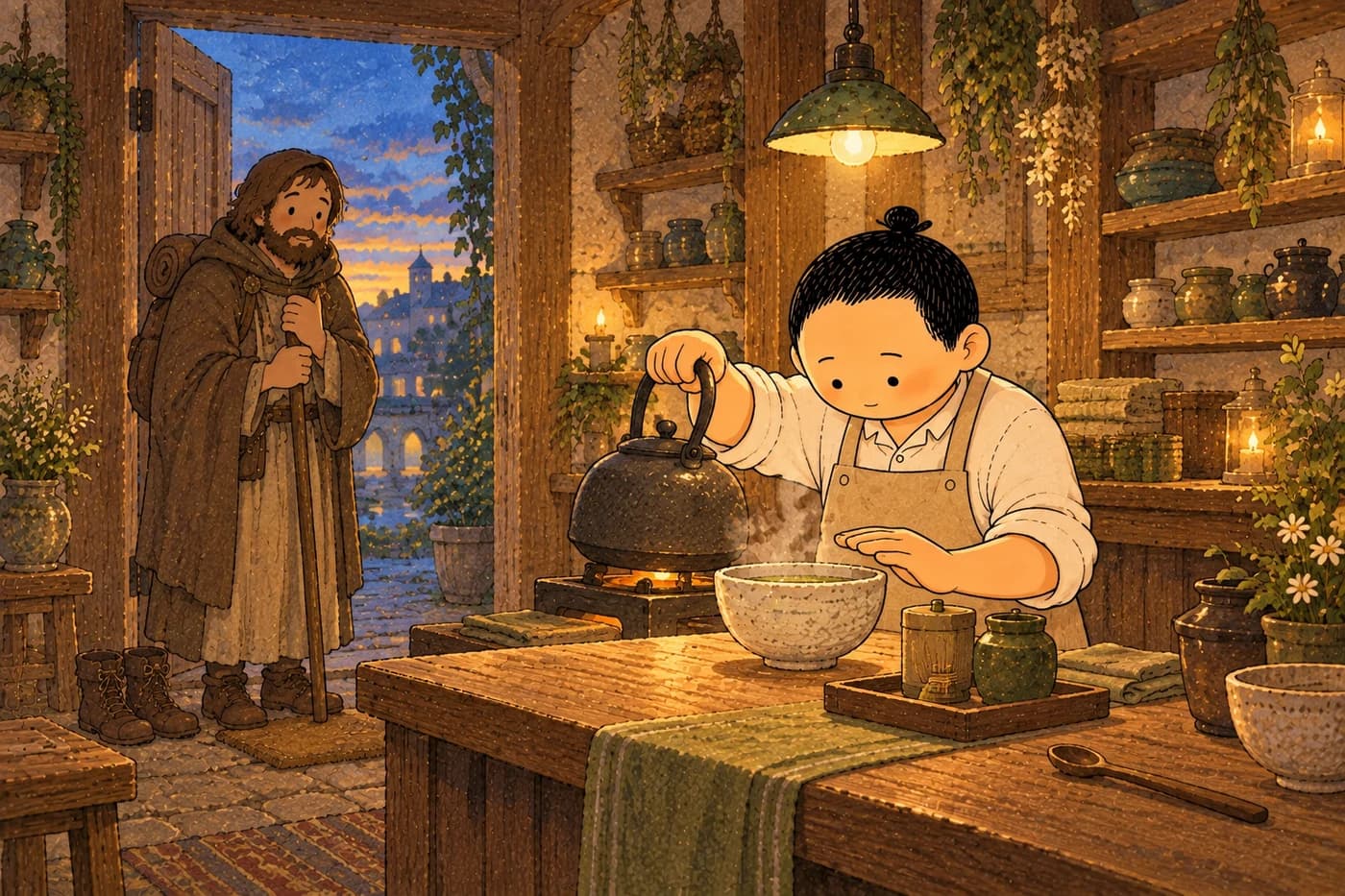
It begins because Mutjo whisks quietly, and in the new world quiet competence is readily mistaken for enlightenment. He is working before dawn, warming the bowl and checking the water, when a pilgrim appears at the door and watches him for nearly ten minutes without speaking. Mutjo assumes the visitor is waiting for the shop to open. The visitor assumes Mutjo has entered a profound state. Both are wrong in a harmless direction.
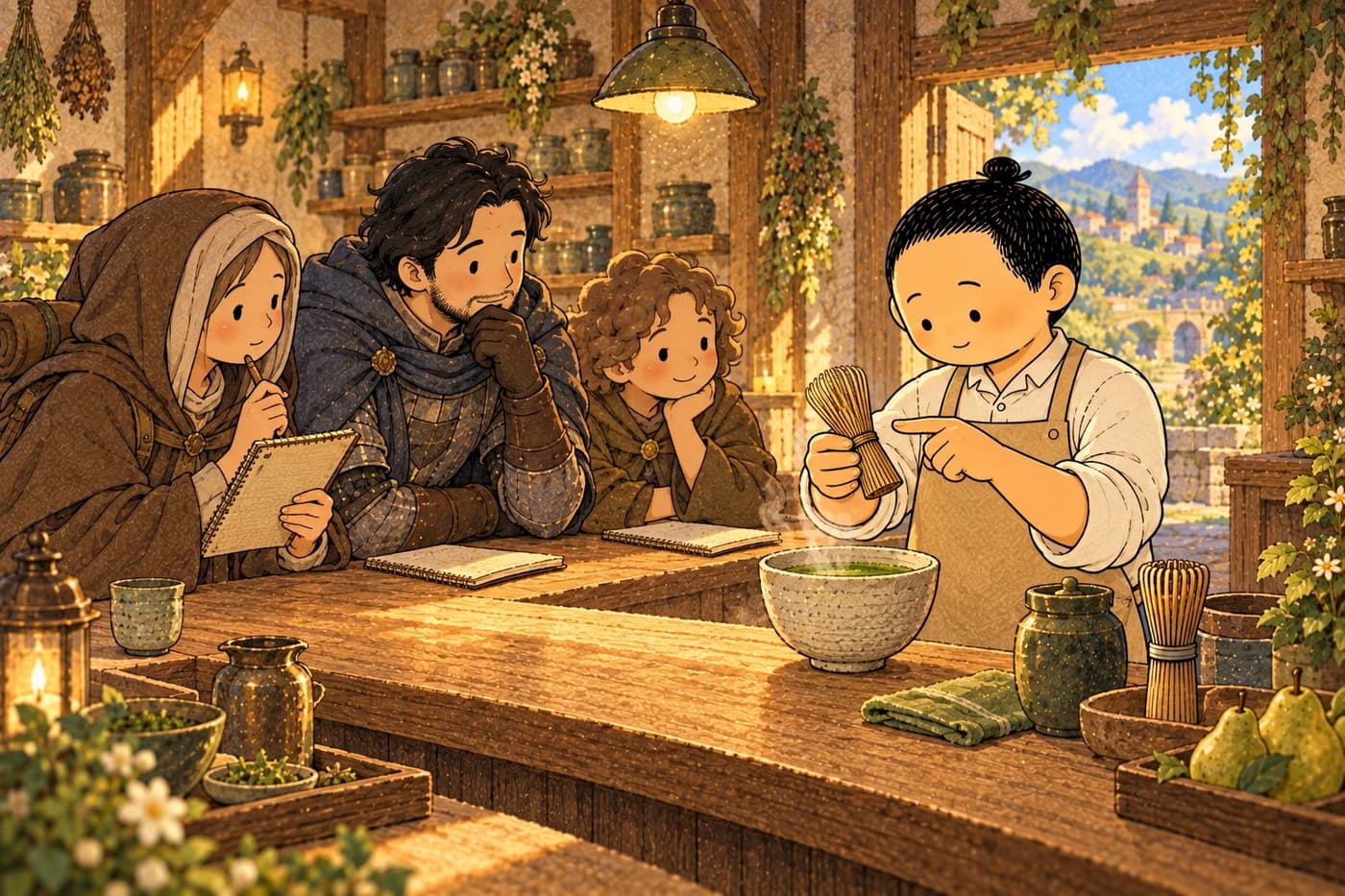
By midday the first group has arrived. They ask large questions. What is the road for? Why does the heart tire? How can a person know when to begin again? Mutjo, who mostly thinks about foam, answers with things like warm the bowl first and do not rush the water. The pilgrims write these down with trembling gratitude. One asks whether the whisk represents the turning of time. Mutjo says it represents a whisk.
The Matji do nothing whatever to discourage the misunderstanding. They line up beside him during the answers like six small green acolytes, deepening the effect considerably. Gutji sits closest to the aisle, holding position when the pilgrims’ robes brush the floor. The other newcomer leans beside the kettle. Katjo inspects each bowl. Yutju discovers the warmest stone and appears enlightened by it. Dotjo supports the row. Itji watches the pilgrims’ pencils. The performance is excellent for business.
Pilgrims begin arriving from the hills. Some bring offerings: pears, ribbons, a brass bell, and one extremely serious chicken. Mutjo accepts the food and returns the ribbons. He has nowhere to hang them. The chicken stays for tea and leaves disappointed that there is no grain. Sir Tetsu keeps the queue in a straight line, though the line becomes a circle whenever someone asks a philosophical question.
Mutjo tries to correct the story. He explains that he is a barista, not a master. He says the Matji are his family, not acolytes. The pilgrims nod reverently, as though humility were the most advanced teaching yet. Hara-san would have recognised the problem. Once, in our old street, she was praised for the wisdom of choosing a dry umbrella. She had simply checked the weather.
One evening a pilgrim asks the smallest Matji for wisdom, directly. Itji stands before the visitor. The pilgrim kneels. Six pairs of eyes turn towards the scene. The fire clicks. The pilgrim waits with an expression of complete readiness. Itji considers, gravely. Then it says the only word it knows.
The pilgrim weeps. Not loudly. One tear, then another, as if a private door has opened. Itji leans towards the tear and then back towards the bowl. Mutjo offers a cloth. The pilgrim bows until his forehead nearly touches the floor. The other Matji remain solemn, although Yutju is visibly trying not to fall asleep.
After that, the story becomes impossible to manage. People come to hear the one word. Mutjo continues whisking. The Matji continue standing in a row. The tea remains good. A sign goes up: PLEASE ASK ABOUT THE MENU AS WELL. It does not help. The queue grows beyond the crossroads.
A young pilgrim begins sweeping the threshold before asking a question. Mutjo shows him how to warm the bowl. The pilgrim repeats the movement, slower this time, and smiles when the water settles. The Matji watch from the sill. This, at least, is a lesson Mutjo recognises: careful work shared between people becomes its own kind of welcome. The young pilgrim dries the bowl and places it beside the kettle. Another visitor notices and begins stacking the floor cushions. Soon the waiting line is doing the small work of opening and closing a shop, less interested in answers than in making room for the next person. At closing, Mutjo lowers the lamp. The six Matji gather around the last warm bowl. The pilgrims leave lighter, the shop remains a shop, and the smallest word in the world has become excellent for business.