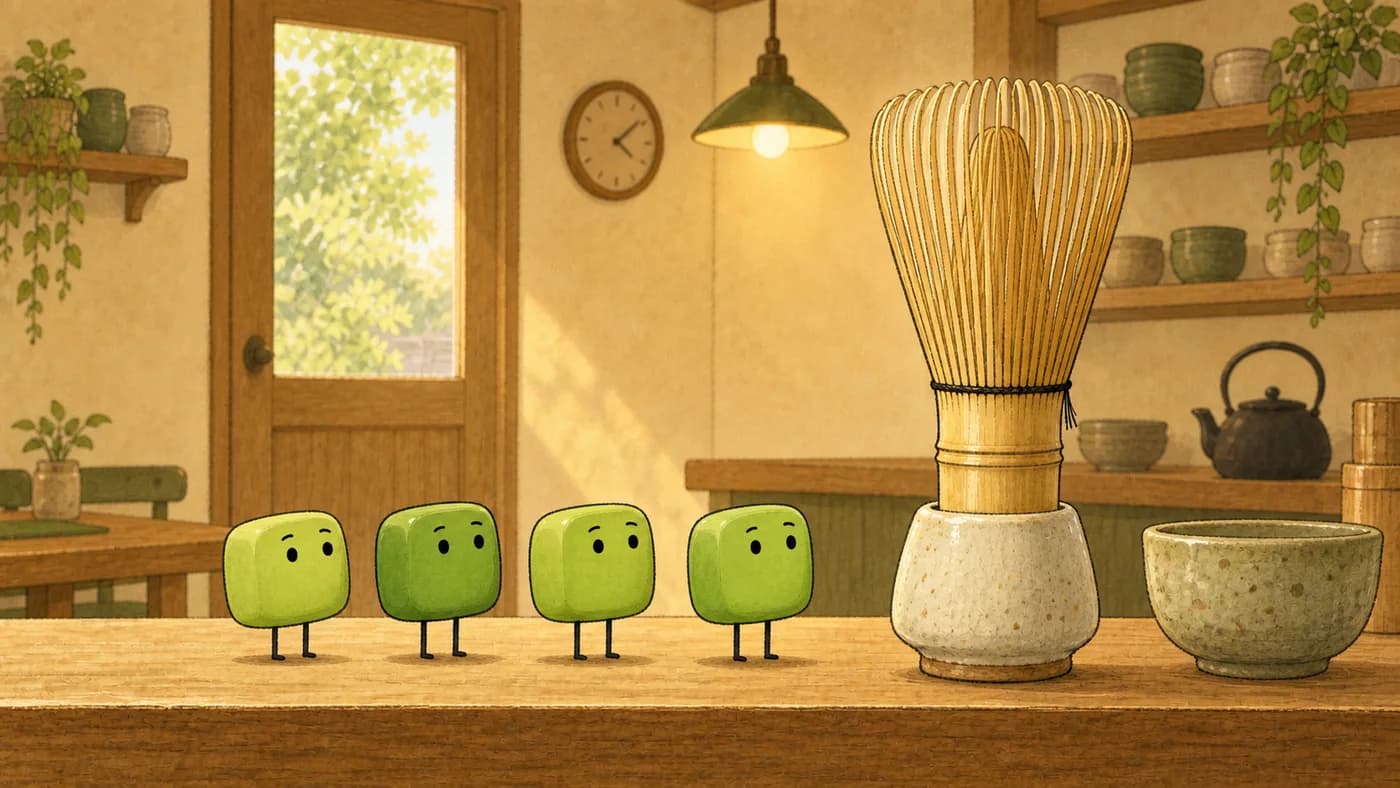
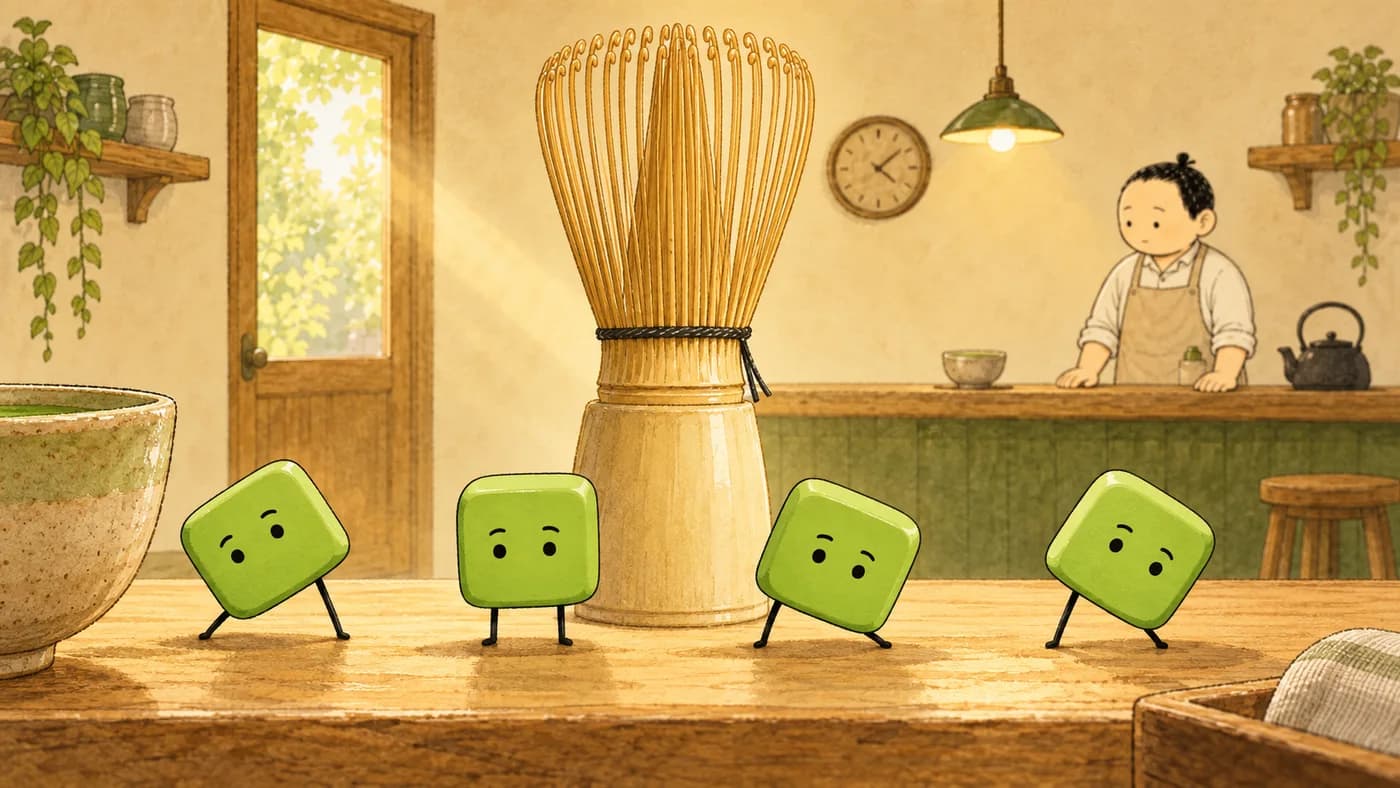
The petition is silent but unmistakable: the Matji wish to whisk. They have watched for weeks. They have studied every bowl. They are ready.
They are not ready.
The bamboo whisk stands in its wooden holder above them, clean tines catching the morning light. Four Matji line up beneath it and lean forward together. Mutjo has learned that this posture means a request has already survived committee.
He demonstrates once more. He warms the bowl, measures the powder and draws the whisk lightly through the water. The foam gathers beneath his hand. When he sets the whisk down, the Matji shift closer until one broad green side rests against the handle.
Mutjo considers the ceiling, the menu board and the good cloths. Then he slides the practice bowl into the middle of the counter.
The first attempt begins with two Matji bracing the handle between their bodies. For one breath the tines make a neat circle. The smallest leans farther. The circle lengthens into a rope of foam that climbs over the rim, crosses the counter and lands on the floor with a soft green slap.
All four stop. Mutjo looks at the puddle. The Matji look at Mutjo.
He hands them a cloth.
Cleanup is quicker than expected. One Matji presses along the wet edge while another leans into the folded cloth. The smallest follows the last pale streak until the boards shine. When the bowl returns, so do the four applicants.
The second attempt uses a firmer brace. The whisk turns twice, catches the surface and sends a spray across the blank wooden menu board. Green drops arrange themselves in a pattern that might be writing in a language with unusually cheerful punctuation.
Mutjo closes his eyes for one respectful second. By the time he opens them, the Matji have already brought the cloth to the board.
Their seriousness makes refusal difficult. They clean, reset the bowl and confer beside the whisk. Then they arrange themselves by height. The lowest cube plants both skinny legs. The second settles on top. A third follows. The smallest climbs last, leaning its full soft-edged body towards the handle.
The tower sways. Mutjo places one hand near it without touching. Four bodies adjust against one another until the movement stops.
Together they put their weight into the whisk.
The tines sweep the bowl. Foam rises in a bright curve, clears the counter, passes the menu board entirely and reaches the ceiling. The sound is modest: a plop, followed by the silence of everyone looking up.
Mutjo privately considers the arc a triumph of engineering. Publicly, he fetches the tall wooden stool.
They clean until dusk. Mutjo wipes the ceiling and upper wall while a two-Matji stack works along the shelf below. The other two press and lean a cloth over the counter. Nobody abandons the task simply because the experiment has become housekeeping.
At last only one small green mark remains above the framed photograph of the perfect bowl. Mutjo lifts his brush. The four Matji gather beneath the mark and tilt upwards. He looks from their faces to the spot.
Some mistakes announce the beginning of a history. Mutjo lowers the brush.
The whisk hangs to dry. The bowl returns to its shelf. Four tired Matji sit below the preserved mark, their legs stretched before them. The smallest looks from the whisk to the ceiling and gives one tiny bounce, considerably more restrained than the foam.
Mutjo turns down the lamp. The café has not become tidier through whisk day, nor has its ceiling improved. It has, however, acquired a historic site. As a man who once lived near an English field containing a protected stone of no visible distinction, I can assure you that this is how such things begin.
In the dark window, the mark is almost invisible. The Matji know where it is. Mutjo knows too. That is enough to preserve it.