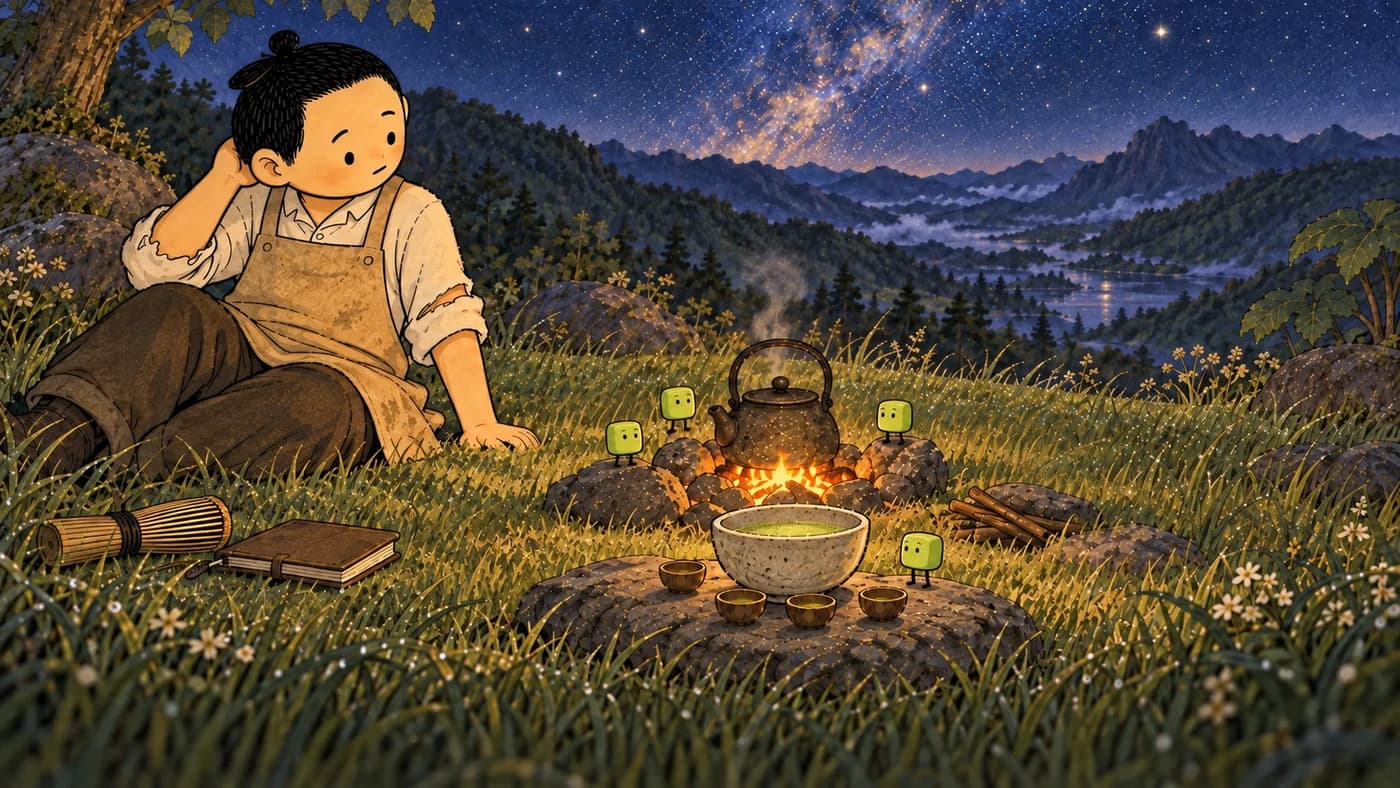
Mutjo wakes on grass he does not recognise, under a sky with far too many stars in it, and his first thought is not Where am I? but Something’s boiling. It is an excellent first thought, practical and entirely his. The grass is silver at the tips. The air smells of wet stone, wild mint, and a distance he cannot measure. For a moment he lies still and listens to the unfamiliar quiet.
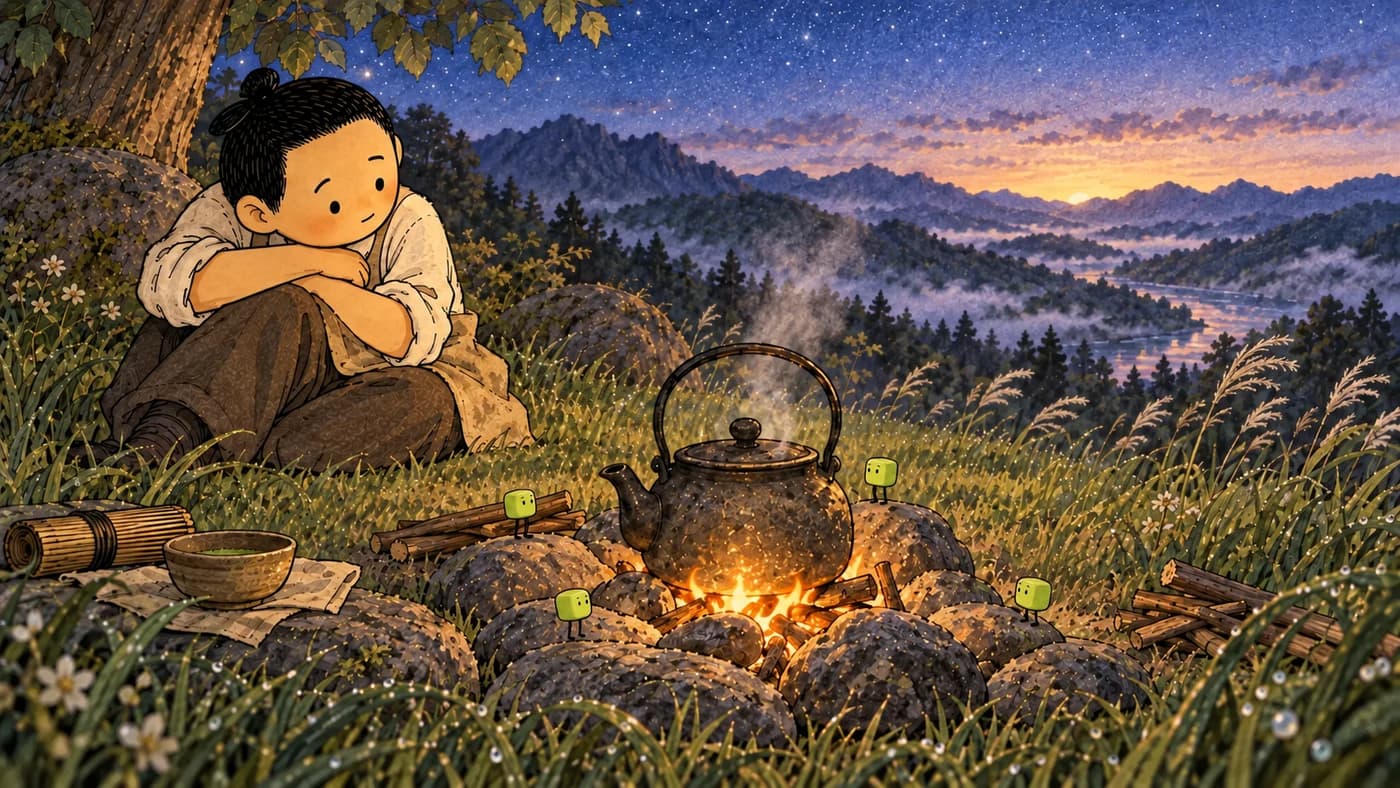
Something is boiling. The Matji have built a small fire, borrowed a kettle from somewhere — the somewhere being a question for later — and are conducting breakfast with the calm authority of creatures who have decided that whatever world this is, it will have proper matcha in it. Four green cubes sit around the kettle, their tiny black legs planted in the soil. One watches the flame. One watches the water. Two watch Mutjo waking.
He sits up. His apron is dusty. One sleeve is torn at the cuff. The familiar wooden whisk is still in his pocket, wrapped in cloth. He touches it, then looks at the kettle. The sight of both steadies him. He checks what else survived: one notebook, a pencil worn flat on one side, two clean cloths, and the sealed packet of green powder. Not enough to explain the journey, but enough to begin the morning. He folds the torn cuff back and stands.
Mutjo asks the Matji how they came here. They answer in their private way, with close attention and a small shift of eyebrows that says the question has been received. Itji leans towards the horizon. Katjo studies the fire ring. Yutju settles beside the warmest stone. Dotjo checks that the kettle has not begun to tip. None of them appears frightened. This is comforting and slightly irritating.
The landscape rises around them in green folds. There are hills beyond the grass, blue at the edges, and a line of trees with leaves unlike any Mutjo knows. A bird calls once from the distance. The sound has three notes and an echo that arrives before the silence. Mutjo reaches for his notebook, finds it in his apron, and writes the date. He leaves the location blank. A blank line is more honest than a guess.
The kettle clicks. Mutjo warms a bowl against the fire and sifts the green powder. He has only a little, carried from the café in a sealed packet. The Matji lean close as the powder falls. It is not ordinary dust; it clings to itself in tiny soft grains, green as new leaves after rain. Mutjo measures carefully, adds hot water, and draws the whisk through the bowl. The familiar whisper rises.
The foam stands up. The Matji gather. They do not cheer. They press close around the bowl, and in their quiet shared attention Mutjo feels the café, the street, the lamp, the whole ordinary shape of home. The feeling is private, held between them. He takes the first sip. It tastes exactly right, which is both reassuring and impossible.
They divide breakfast. Mutjo drinks slowly. The Matji receive tiny drops in warmed acorn caps, balanced on the flat stone beside the fire. The water is good. The fire is steady. A breeze travels down from the hill, flattening the silver grass in a long bright line. Mutjo watches it reach the clearing. The Matji turn with it, then settle again beside their cups while the unfamiliar bird calls three notes.
He does not remember how they came here. The Matji either do not know or do not consider it relevant to the foam. I confess that I, your narrator, followed them some while later by a much less interesting route; but that is a story for another pot. For now the hills are green, the water boils, and the first cup of a new morning is ready. Some things, it turns out, are true everywhere.