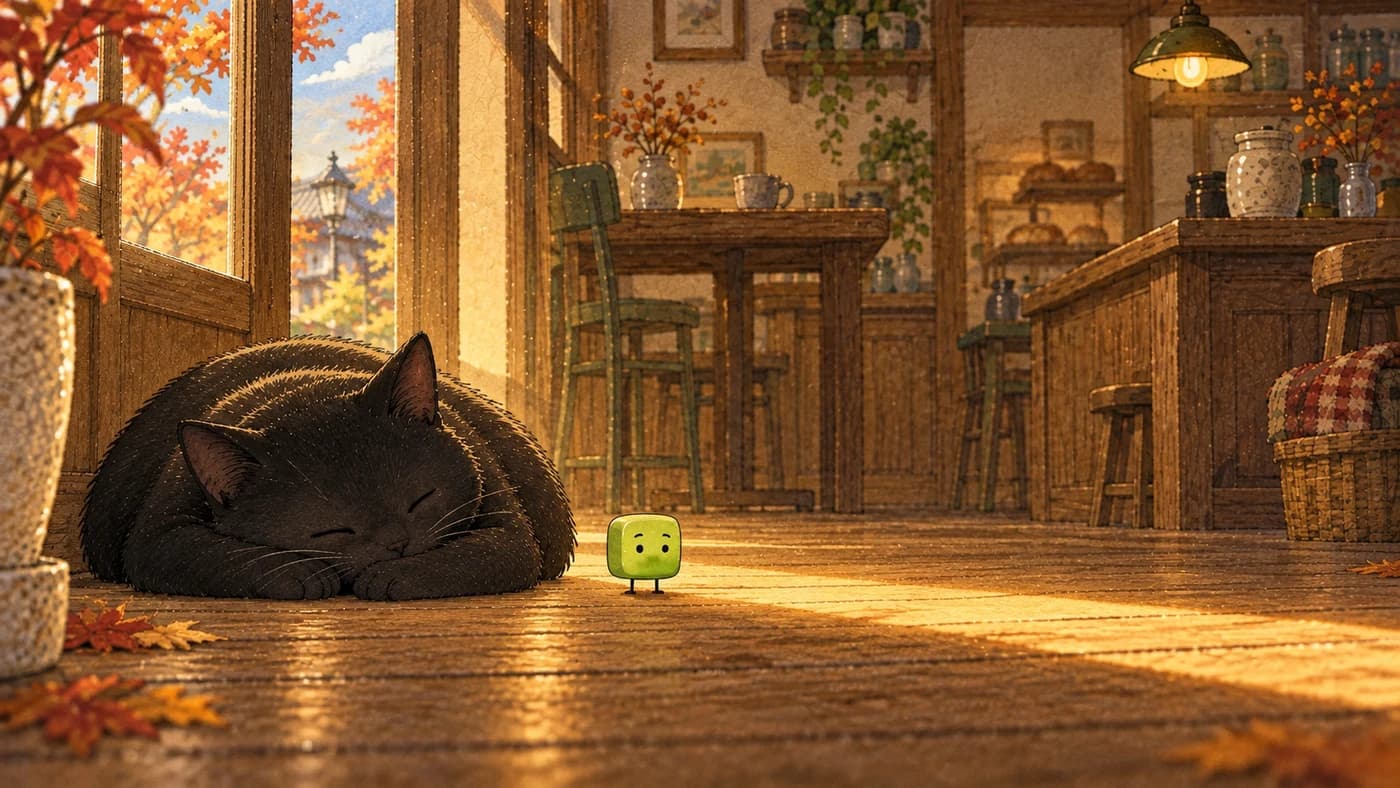
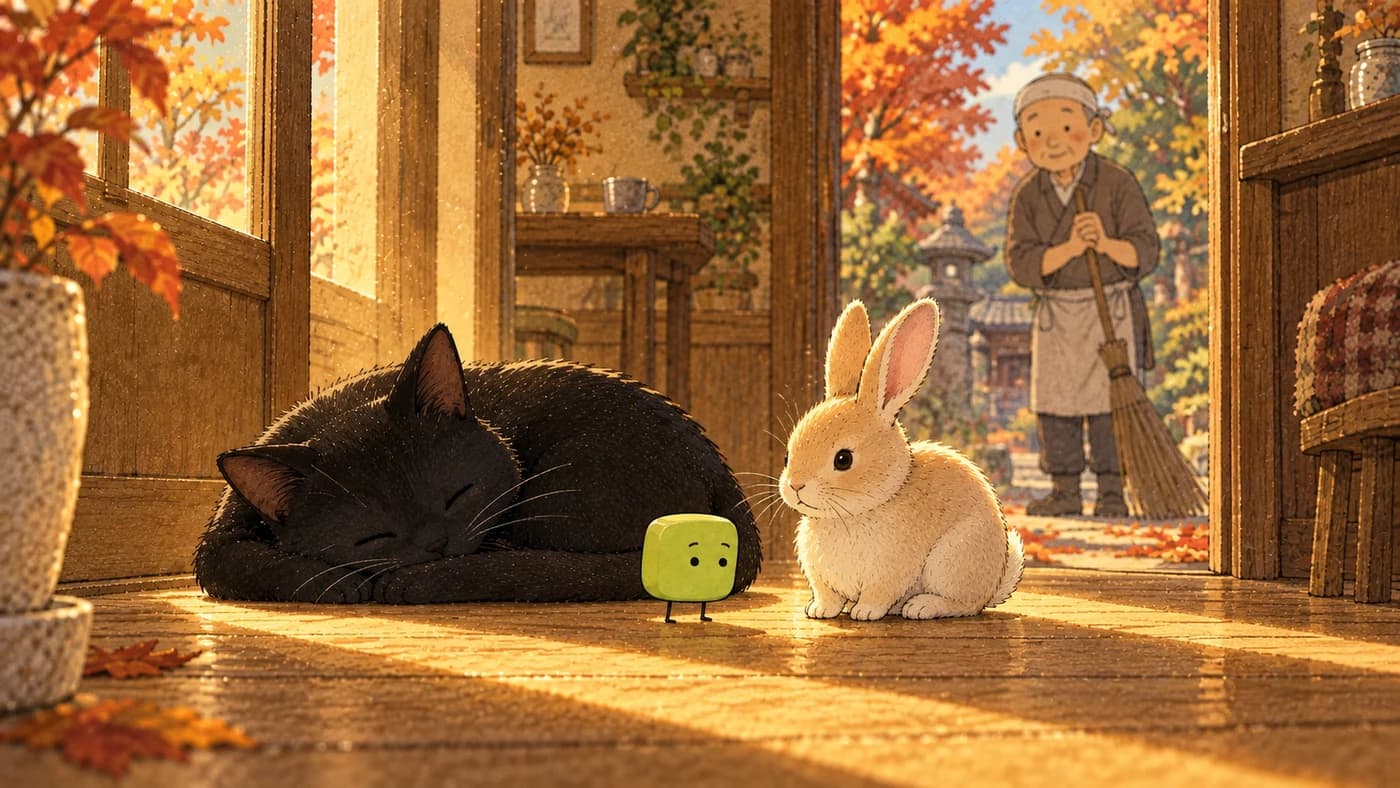
Autumn narrows the café’s great sunbeam to a single golden stripe. In summer it reaches the counter, the window, and half the floor. By October it arrives through the glass like a visitor with a very specific appointment. Claims are filed at once. Kuro, by ancient treaty. Yutju, by temperament. And a newcomer: Yuzu, a rabbit from the shrine hedge, with sun-warmed fur and no concept whatever of queueing.
Kuro occupies the left end of the stripe. Yutju settles in the middle. Yuzu enters from the hedge, crosses the café threshold as though she owns the lease, and sits precisely where the light is brightest. The rabbit’s ears lift. Kuro’s tail moves once. Yutju’s eyebrows rise. Outside, Gen-san stops sweeping. The street understands that a matter of state has begun.
The standoff lasts a full morning. Cat, Matji, and rabbit arrange themselves around the stripe like nations at a border, each pretending the others are weather. Mutjo steps over them with a tray. He opens the window slightly. The beam shifts by one centimetre. All three parties shift with it. A customer sits down and discovers that the best seat is occupied by a rabbit. She chooses the second-best seat without complaint.
Ito-san is solemnly summoned. He arrives with his notebook, cap straight, and the expression of a man who has been waiting his whole career for a jurisdictionally delicate sunbeam. He asks for statements. Kuro gives none. Yuzu gives a twitch of the nose. Yutju leans deeper into the light. Ito-san writes these facts in separate columns and underlines all three.
The settlement, when it comes, is elegant. The sunbeam moves; therefore the seating shall rotate with it. Morning end to Kuro, midday to the rabbit, afternoon to Yutju, with joint occupancy during transitions. Mutjo marks the hours on a little card. Ito-san copies the card into his notebook and stamps it. The stamp lands slightly crooked. He considers starting again, then decides that a treaty should show evidence of being made by living people.
For several days the arrangement works. Kuro leaves at noon with the dignity of a monarch changing rooms. Yuzu waits until the exact agreed moment, then folds herself into the light. Yutju arrives in the afternoon, warm and content, while the Matji watch from the counter. Hara-san says it is the most organised rabbit she has ever seen. Ume-san says this proves nothing about rabbits generally.
The transitions are less successful. Kuro’s tail crosses Yuzu’s nose. Yuzu’s ear covers Yutju’s face. Yutju leans against Kuro’s side, and Kuro permits this only because the sunbeam is warm. The Matji begin sitting in the margin, where the light is thin but shared. Itji falls asleep with one eye in brightness and one eye in shadow. This is considered a philosophical achievement.
On the coldest morning, the sunbeam is no wider than a ribbon. Kuro follows it from the windowsill to the floor. Yuzu arrives before her allotted minute and settles against the strip’s leading edge. Yutju joins at the middle, where the schedule allows nobody to remain for long. As the light creeps across the boards, each begins to shift; instead, the three bodies meet and stay together. Ito-san raises his watch, then lowers it. Nobody reports a formal breach.
They remain in one warm heap while the winter sun crosses the café. At dusk, Mutjo lowers the lamp and the golden stripe fades, but none of the three moves. Ito-san slides the stamped treaty card beneath Hana-chan’s homework, where it serves better as a paperweight than a schedule. Yuzu’s nose twitches once against Kuro’s tail. Yutju sleeps between them. The street reaches its final ruling without another stamp. Some agreements, Mutjo notices, succeed by failing.