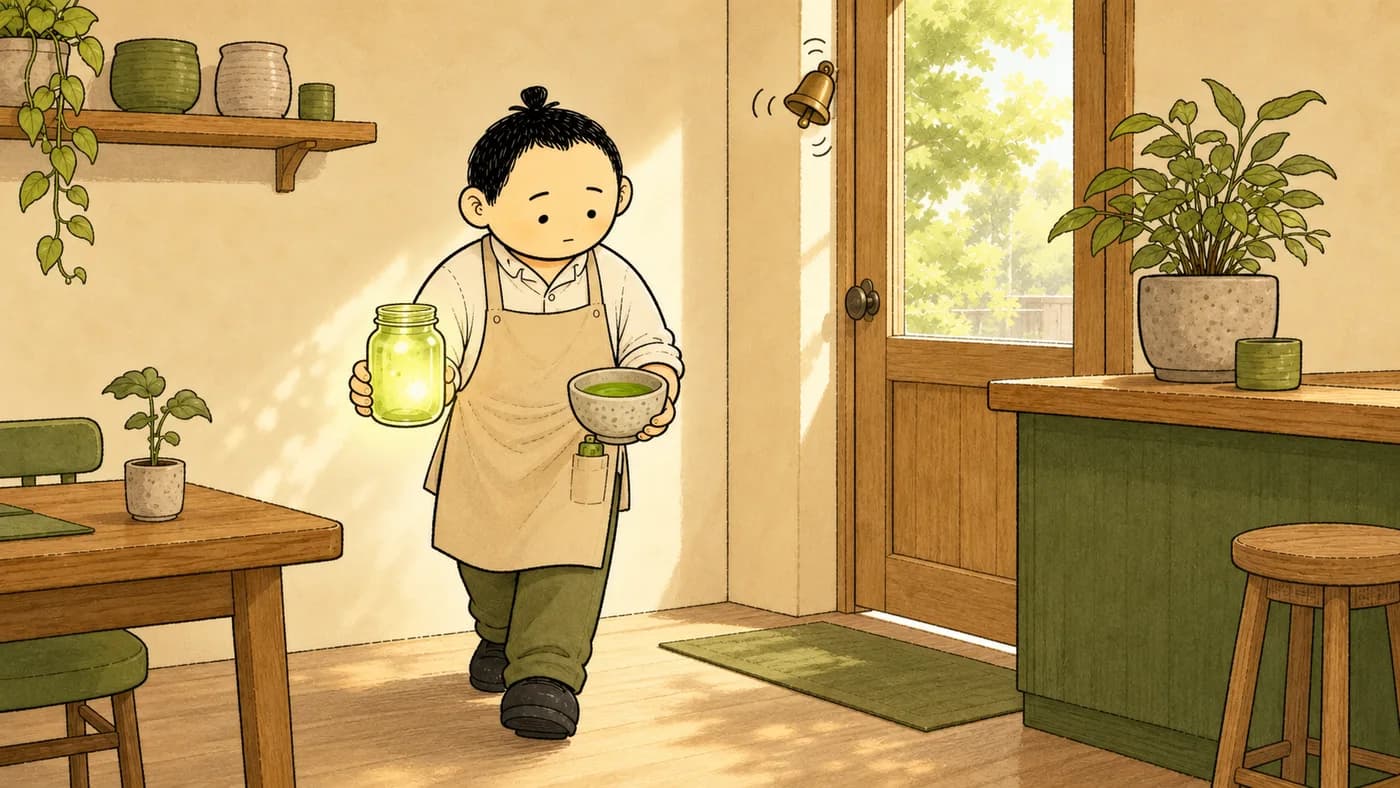
It happens on a Tuesday, which is how important events usually enter our neighbourhood: without music, witnesses, or any respect for the work already under way. Mutjo is carrying the little glass jar in one hand and a fresh bowl of matcha in the other. He has made the journey from back room to counter many times. Today his elbow finds the shelf.
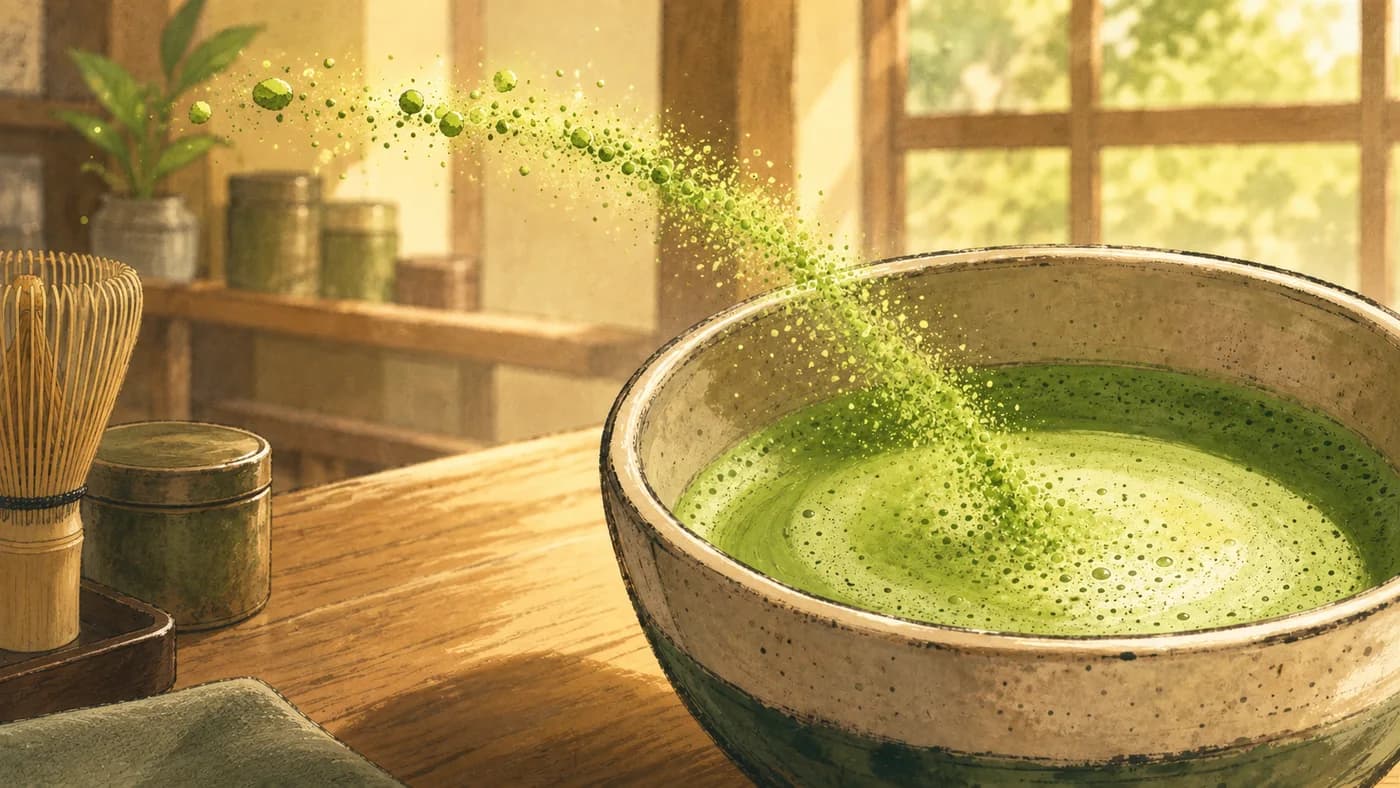
The jar tilts. A pinch of mysterious green powder rises into the light and hangs there for one impossible instant. Mutjo reaches for it, forgetting that both hands are occupied. The powder falls into the bowl.
The matcha does not spill. Its foam shivers in a ring, then another. The surface draws inward as though taking a breath. A soft green corner pushes through, followed by a tiny square body with two close black eyes, two quiet eyebrows and two skinny black legs.
Mutjo lowers the jar. The little creature stands in the bowl, blinking foam from its edges. It looks at the counter, the kettle, the window and finally at him. Neither of them has prepared anything suitable to say.
“Matji!” it cries.
The sound is bright and questioning. It is answered at once by a second cry from inside the bowl.
Mutjo bends closer. The first creature steps onto the rim, tests the glazed curve with one foot and hops down onto the counter. Behind it, the foam gathers again. A second green face appears, then a third. Each arrives with the same astonished eyes and its own particular way of meeting the room: one watches the whisk, one studies Mutjo, and one turns towards the street as if it has heard the bicycle bell outside.
The fourth takes longer. A small mound of foam rises, subsides, and rises once more. The three on the counter lean towards it. Their attention seems to warm the air. At last the smallest cube emerges and plants both legs beside the bowl with the grave satisfaction of someone who has completed difficult travel.
Four Matji now stand where one cup of tea was meant to be. Mutjo understands the cry not as an individual name but as a word for their kind, offered before any separate names have revealed themselves. For today, that is enough.
He sets out a clean saucer. None of them uses it. They arrange themselves along the polished counter instead, close enough for their shades of matcha green to look like leaves from the same branch. One is slightly deeper, one slightly brighter, but the family likeness is unmistakable.
Mutjo tries to make another bowl. His hands need the ordinary work. The four Matji form a row and watch him warm the ceramic, sift the powder and lift the whisk. Their eyebrows shift with every movement. When he pauses, they lean closer. When the foam rises, the smallest gives one restrained bounce.
The café has never felt so thoroughly observed. Mutjo glances at the empty seats, then at his new audience. He has spent a long time believing quiet meant that nothing was happening. Now it contains tiny feet on wood, four sets of eyes, and the soft settling of bodies finding where they belong.
At dusk the street sees light in the window and assumes Mutjo has finally found customers. Inside, the four Matji sit beside the whisk while he closes the jar and places it carefully beyond the bowl. He smiles before he notices he is doing it.
The smallest turns towards him. “Matji,” it says again, more softly.
Mutjo bows. Outside, the Tuesday traffic passes without learning what has changed. Inside, one accidental cup has become a family, and the quiet shop has heard its first new word. The kettle begins to sing.