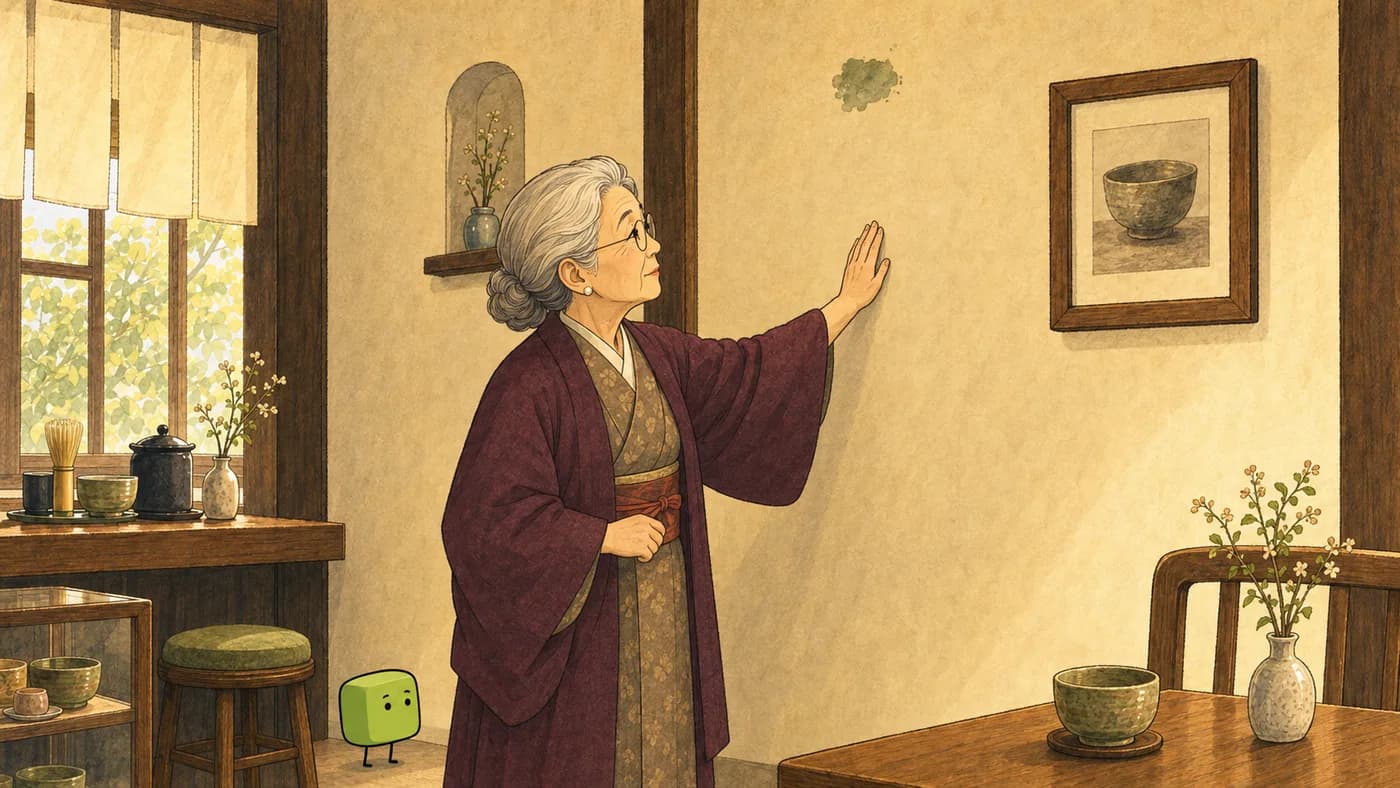
It is Hara-san’s idea. “You should have a picture,” she says. “Shops need a picture.”
She chooses the open patch of wall beneath the photograph of the perfect bowl and beside the small green ceiling mark. Mutjo looks at the space, then at the four Matji. They have already begun arranging themselves on the counter.
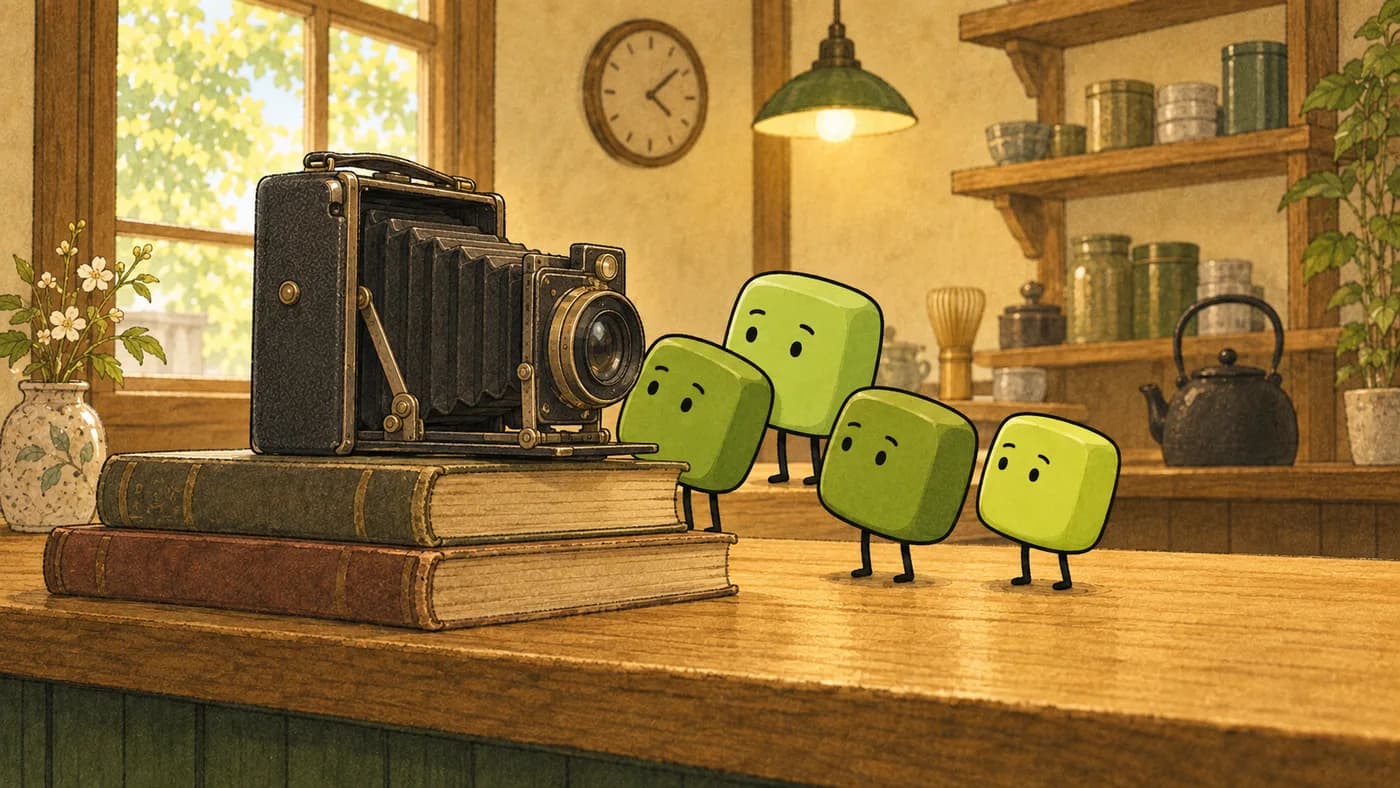
The old bellows camera rests on a stack of books. Its lens catches the café window in a dark round reflection. The Matji approach, inspect it, retreat, and approach again. One studies the tripod foot. Another stands where the lens is pointing and seems disappointed that nothing happens.
Mutjo adjusts the books until the camera sits level. Hara-san watches from her table with the grave attention of someone supervising a household repair.
The first arrangement is tallest to smallest. Their differences are so slight that the order changes twice before anyone is satisfied. The second arrangement is smallest to tallest, which produces the same argument in reverse. The third becomes a square, although one Matji is already leaning out of it.
Mutjo sets the timer and hurries behind the counter. The mechanism begins to tick.
At the first tick, all four Matji face the camera.
At the second, the smallest notices the preserved ceiling mark.
At the third, one cube attempts to change places with another. The formation opens, closes and becomes something best described as everywhere. Mutjo raises one hand, far too late to conduct them.
The flash catches the disagreement with perfect clarity. One Matji is upside down, balanced against the sugar jar. One is in mid-leap, its two skinny legs clear beneath it. A third holds a crisp tilted pose. The fourth remains planted at the centre with the patience of a person who expected this outcome.
Mutjo is caught mid-blink.
For a second the café is white with after-light. Then the Matji gather around the camera as though the picture might already be visible inside it. Hara-san returns to her crossword. Her mouth has softened at one corner.
The print develops slowly in a shallow tray. Mutjo lifts it by the edge while four green faces appear on the paper. Every face is sharp and readable. Every pair of eyes looks directly towards the lens, despite the bodies having reached no agreement about which way was upright.
The composition is crooked. The sugar jar occupies too much of one corner. Mutjo looks tired, surprised and more cheerful than he intended. The photograph is technically imperfect and entirely honest.
Hara-san studies it over her spectacles. “The good frame,” she says.
Mutjo fits the dry print behind the glass. The Matji gather below while he carries it to the chosen place on the wall. One leans towards the left corner; another towards the right. He shifts the frame by half a centimetre. Their eyebrows settle.
The picture hangs above the bowl photograph. The old green mark remains nearby like punctuation added by the family itself. Hara-san asks Mutjo to lower the frame slightly. He does. From her chair, the faces now meet the eye of anyone entering the shop.
The Matji stand beneath their picture and look up. The upside-down one in the photograph is still upside down. On the counter, its owner turns its whole body as if checking whether history has been accurate.
Mutjo dusts the frame. Hara-san returns to seven across. The timer, no longer required, gives one final click from the books.
At closing, Mutjo lowers the lamp and pauses before the wall. The perfect bowl records a standard. The green mark records an attempt. The new photograph records four sharp little faces and one man caught blinking among them.
He leaves it exactly as it is. Shops need a picture, Hara-san said. This one does more than decorate the wall. It proves that for one clear instant, everybody looked.