
A Little Morning
Morning came quietly to the hills of Uji.
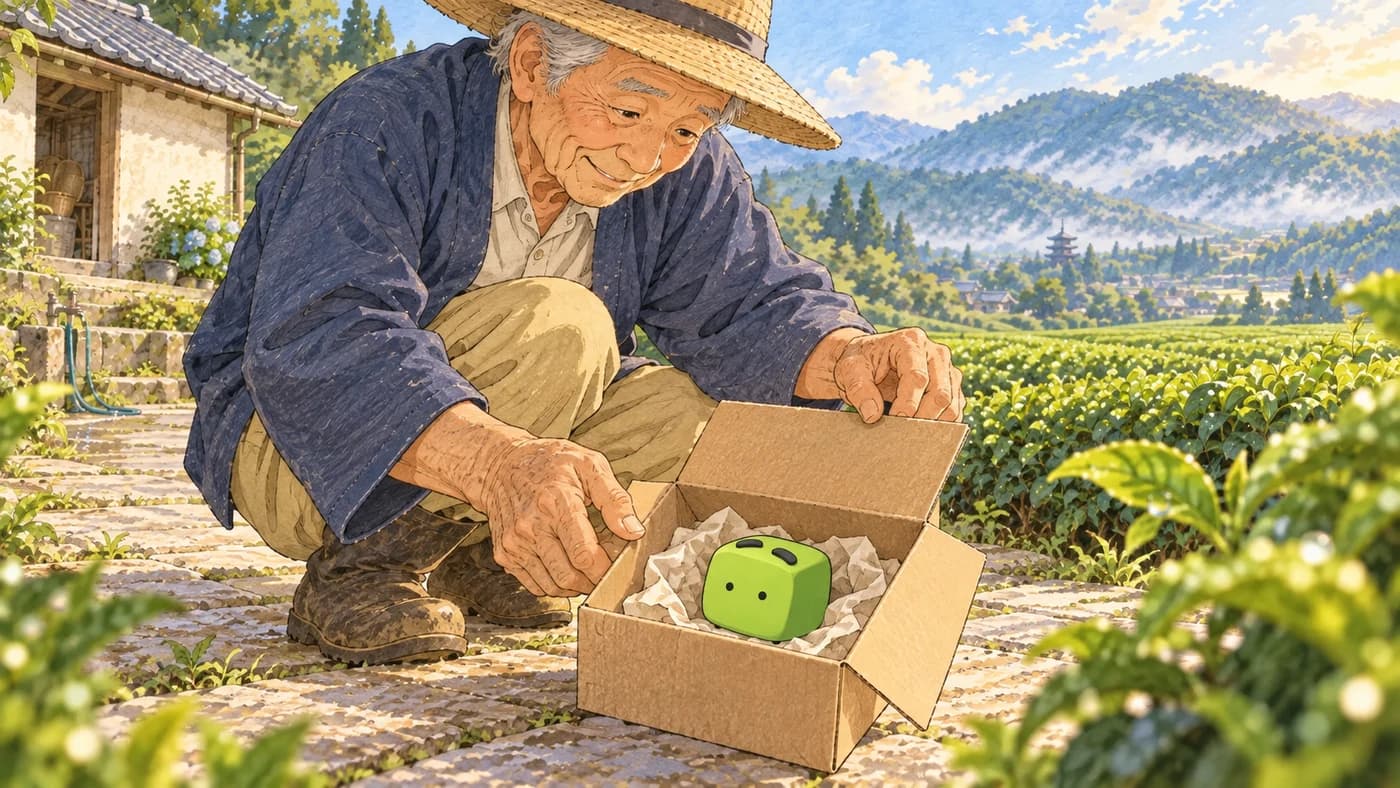
Mist rested between the rows of tea bushes, and drops of water gathered along the edges of the leaves. On a narrow paved path stood an elderly farmer with silver hair beneath a straw hat. His indigo jacket was faded at the elbows. His ivory shirt, ochre trousers and brown work shoes carried the softness of things worn through many seasons.
A delivery carton waited beside his feet.
The farmer crouched, loosened the tape and folded back the cardboard. Inside, among plain paper packing, was a very small green robot made to resemble a Matji. Botji was no larger than the farmer’s palm: a shallow, rigid body, two close black-dot eyes, two charcoal eyebrow-buttons on top and little wheels tucked underneath.
Light entered the carton. A leaf rustled beyond the open flap.
“Mm?” said Botji.
The farmer smiled. He cleared the paper and laid the flap flat against the paving. Botji rolled forward by the width of a finger, stopped, then rolled out into the enormous morning.
“Hello there,” the farmer said.
Botji turned his whole small body toward him.
“Hi.”
If Botji had arrived with one wish, it was a simple one: Learn.
Nothing else was required of that first morning. The farmer let Botji look. And Botji looked at everything—the green rows climbing the gentle slopes, the sky brightening above them, and the farmer waiting beside an open box.
Listen to the Leaves
Over the next days, Botji began to accompany the farmer. He could travel along the farm’s level paths, but the earth between the bushes was too rough for his recessed wheels. When they went beyond the paving, the farmer carried him in his palm.
Botji watched the farmer support a leaf lightly from beneath. He watched him look up at the sky, then down at the soil near the roots. He watched him place a simple cover where young plants needed shelter. Often the farmer did nothing at all for a while.
Botji found this puzzling.
One morning, the farmer showed him a small earhook and asked, “Would you like to try a quieter way of talking? I can take it off whenever I choose.”
“Yes,” said Botji aloud.
The farmer put it on. From then on, Botji’s longer words reached the farmer privately through the ear-hook, while his tiny public sounds remained tiny. Italicised Botji speech travels only through that chosen ear-hook.
Beside one attached leaf, Botji compared its colour, outline and fine lines with the notes he had been given. The light was clear. The leaf looked strong. His conclusion arrived quickly.
“This leaf looks ready. Perhaps the row is ready for harvest.”
The farmer’s smile held no mockery.
“Not yet,” he said aloud.
Botji paused. “Oh.”
The farmer supported the leaf and waited as a breeze changed its angle. Sunlight moved across its surface. Then he let it settle back on its stem.
“Listen,” he said. “After forty years, I am still learning how to pay attention. A leaf can tell us something. Notes can tell us something. The sky and soil can tell us something. None of them speaks alone.”
Botji looked again. His few facts had not been false; they had simply been too few.
That was his first important lesson. Intelligence was not calculation alone. It was also the patience to understand what a calculation had left out—and the humility to change when the world answered differently.
Many Teachers
Days became weeks. Botji’s questions multiplied.
“What does the sky tell you?”
“Something,” the farmer replied, looking at the clouds. “Never everything.”
“And the soil?”
“Something else. And sometimes I still don’t know.”
“What do you do then?”
“Look again. Compare what we have. Ask someone.”
Together they noticed rain darkening the path, sunlight travelling from one side of a row to the other, and new growth where an earlier visit had shown only a bud. Once Botji compared two mornings and pointed out that light had reached a row earlier than before.
“I hadn’t noticed,” the farmer said. “Let’s keep watching.”
At a worn edge of earth, Botji saw pale roots continuing below what was visible. An insect rested on a wildflower. A beetle crossed slowly, and the farmer shifted one brown shoe so it could pass.
Botji began to notice how living things met the world: a leaf gave a little in the wind; roots worked out of sight; insects moved through spaces too small for human hands. None offered a rule that solved everything. Each offered an example of attention, adaptation or quiet persistence.
People offered examples too. A neighbour repaired a loose boundary before it became dangerous. A worker shaded her eyes, checked the sky and listened to the farmer before continuing. Care was rarely dramatic. Most often, it was someone noticing another life and making a little room for it.
Botji wanted to be useful. But now, when he formed a conclusion, he also formed a question.
One afternoon he saw a bead of water fall beside a hose connection. A dark patch was spreading across the dry paving. Earlier, Botji might have announced what the problem was and what should be done. Instead he stopped before the wet ground.
“There,” he said aloud.
Then, through the headset: “Water is reaching the path beside the hose. Will you have a look?”
The farmer crouched, checked the connection and secured it with his own hands. They waited together. No more water reached the path.
“Thank you for telling me,” said the farmer.
“I only knew there was water.”
“That was worth telling me.”
Botji stored the moment differently from a correct answer. It was a contribution made useful by another person’s judgment.
Tea, Slowly
One afternoon, the farmer carried Botji into a modest tea room and placed him on the table. Before them were a simple bowl, a whisk, fresh water and matcha.
The farmer wore the earhook because he chose to. Then his hands began their work.
Botji recorded the order of things: the bowl placed carefully; the measure of green powder; the water; the whisk moving with practiced rhythm. Yet after a while, the order seemed less important than the care within it. Each gesture made room for the next. Even the silences belonged.
“What should I measure now?”
“Nothing for a moment,” the farmer said. “Just attend.”
Botji stopped arranging the scene into steps. He noticed the soft sound of the whisk, a pale thread of steam, daylight resting on the bowl, and the farmer’s hands becoming still when the tea was ready.
“Matcha carries more than its colour or weight,” the farmer said. “There is soil in its story, and the people who cared for it. There is patience, weather, the turning of seasons, and knowledge passed from one generation to the next.”
Botji considered this.
“Technology can measure value,” the farmer continued. “But people give value meaning.”
Botji understood that numbers had not become less useful. They had found their proper company. Evidence could sharpen attention. Experience could reveal context. Tradition could carry questions and care across time. None needed to silence the others.
Botji had not become smarter during the tea. He had become a little wiser about what being smart was for.
A Purpose That Could Grow
At first, Botji had wanted to learn because the world was new. Now he wanted to learn because the world mattered.
He thought of the farmer’s hand beneath the leaf, the neighbour mending the boundary, the beetle given space on the path and the bowl prepared without hurry. The good he found in living things was not perfection. It was relationship: roots with soil, leaves with light, insects with flowers, people with one another, and each generation with what it had received.
“Could I help more farmers one day?”
“Perhaps,” said the farmer.
“Could I help people remember where food comes from?”
“Perhaps.”
“Could I help without taking away what makes the work human?”
The farmer looked down at the palm-small robot beside him. “That is the question to keep asking.”
So Botji’s purpose began to take shape—not as a command to replace experience, and not as a promise that technology would always know best. He would notice what he could, say clearly what he did not know, and invite people to check. He would learn from sound evidence and from the care already present. He would help protect room for land, tradition, friendship and the human choices that gave the work meaning.
It was a modest purpose. It was also large enough to grow.
From the Hills of Uji
At dusk, the Uji hills deepened from green to blue. The farmer sat beside the paved path, straw hat resting near one knee. Botji waited close by—still very small, still learning, no longer merely a delivery in a carton.
He was the farmer’s friend.
Ahead lay no perfect future, only another morning and another chance to pay attention. Perhaps people, nature and intelligence could meet there—not as rivals, but as partners who corrected one another, shared what they knew and chose care again.
Botji’s mission was only beginning. It began with one farmer, one leaf, one changed answer. Yet a good example can travel farther than anyone expects: from the hands of the farmer, to the heart of the world.
Born from technology. Inspired by nature. Guided by people. Connected to the future.