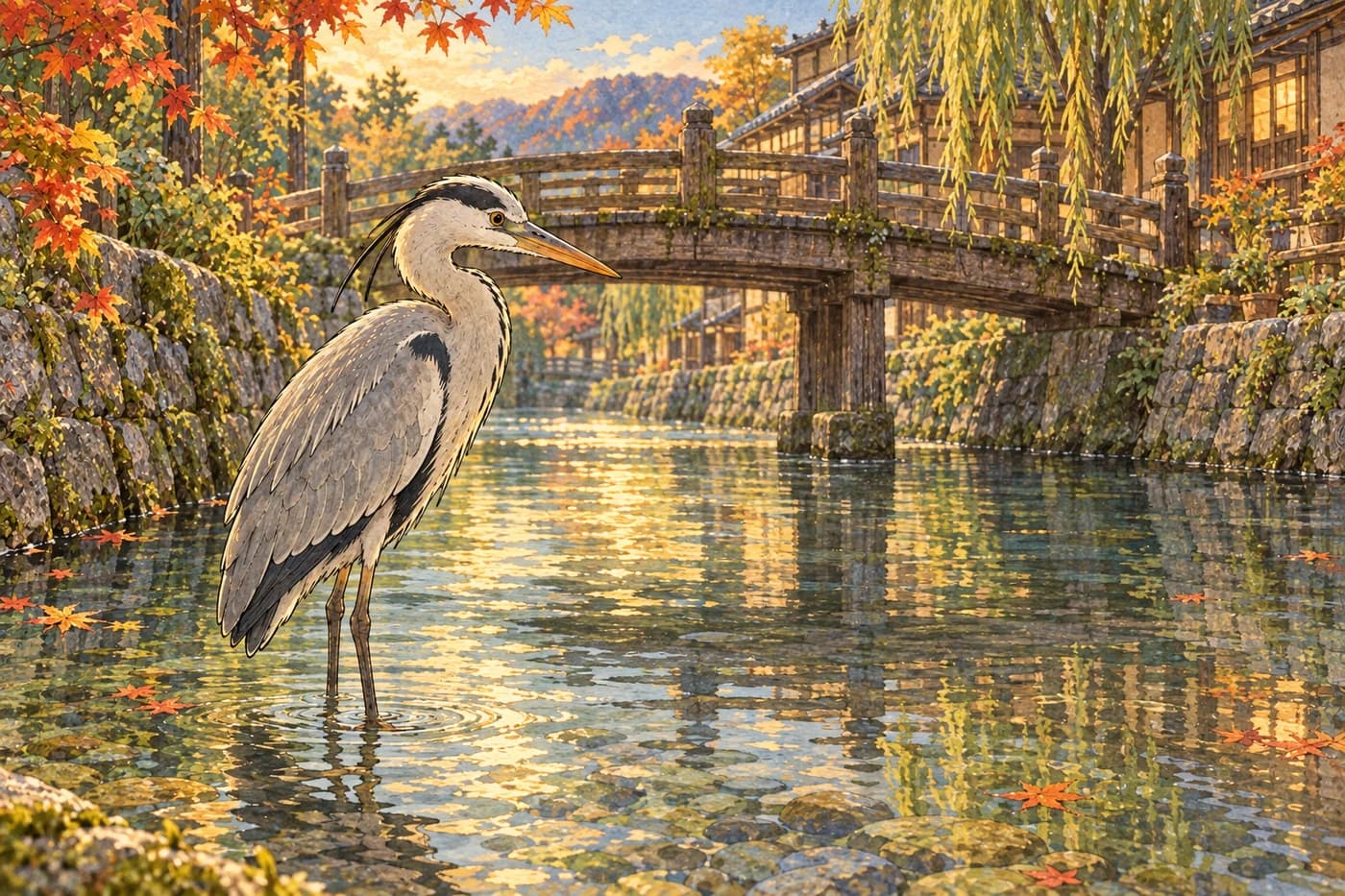
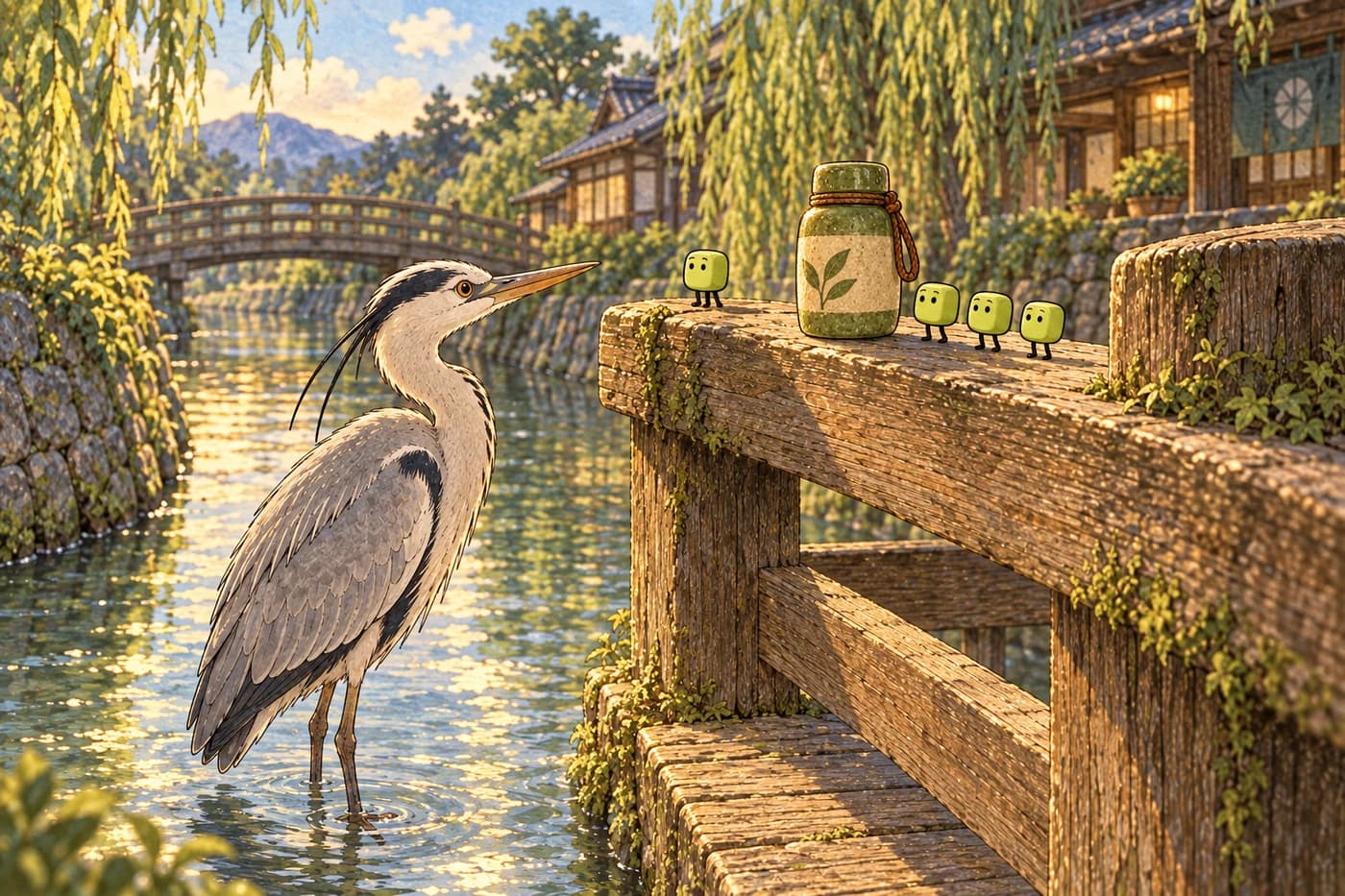
The canal has a magistrate. His name is Shibu, and he is a grey heron who stands in the shallows like a folded umbrella while judging everything that moves. The fish. The current. The quality of the morning. He has the long legs of a patient official and the expression of one who has read every petition and found most of them unnecessary.
Katjo encounters him on the timber bridge rail during a delivery run. Mutjo has sent four Matji with a small flask for Hara-san, who is waiting beside the canal with her newspaper. Katjo stops when she sees Shibu. The heron turns one eye. Katjo turns both. The flask remains upright between the Matji, because even a moment of wonder must observe basic standards.
They do the thing each does best. They stand very still and look at things properly. Shibu watches a minnow pass beneath a blade of weed. Katjo watches the minnow, the blade, and the pattern of light on the water. A bicycle rattles across the bridge. A crow complains from the roof. Neither bird nor cube moves. The canal continues its argument with the stones.
An hour passes. Passers-by assume they are looking at statuary, a new installation perhaps, though the heron is considerably more elegant than most public art. A child whispers that the little green square is waiting for permission. Her mother whispers that the heron is giving it. This is not quite right, but it is close enough to truth for a child.
Somewhere in that hour, without a sound, an entire professional respect is negotiated. Shibu does not startle Katjo with a sudden wing. Katjo does not interrupt Shibu’s inspection by leaning into his shadow. When the wind brings a scrap of paper down the canal, both watch it pass. When a fish breaks the surface, both follow the ripple. The strictest bird on the water and the strictest small person on the street have become colleagues.
Hara-san eventually arrives and finds Katjo still on the rail. She places her newspaper on the bridge post and waits. The other Matji sit below, arranged in a neat row beside the moss, their eyebrows lifted towards the water. Mutjo’s flask is opened. Hara-san receives her matcha. Shibu receives no cup, because a heron has no obvious use for one, but Katjo tilts towards him in formal acknowledgement.
On Thursdays the arrangement repeats. Shibu stalks past the café window, grey and deliberate, and inclines his head one degree. Katjo returns exactly one degree. The exchange is so precise that Ito-san begins measuring it with his pencil. He decides not to create a file. Some matters are better left outside official paperwork, particularly when the parties have already reached a satisfactory agreement.
Poko tries to join the canal meeting and is removed by Sato-san before he can fall into the water. Kuro watches from the windowsill and appears to find the whole business obvious. Ume-san says Shibu has always had excellent manners. Kobayashi-san says the heron has never paid for tofu. Hara-san says neither has Kuro. The street accepts this as a balanced legal opinion.
Hara-san calls this a friendship conducted by millimetres. Katjo seems satisfied with the description. The canal approves. Even the fish appear to accept the arrangement. Before sunset, a minnow breaks the surface beneath them. Shibu’s beak turns by one exact degree; Katjo’s eyebrows follow the ripple. Neither disturbs the other’s concentration. Hara-san lowers her newspaper just enough to witness the exchange and raises it again before either official can object. At sunset, Katjo returns to the café and rests beside the window, carrying the canal’s green reflection on one soft edge. Outside, Shibu stands in the shallows. Two patient officials continue to keep watch over a morning that, by their standards, remains under review.