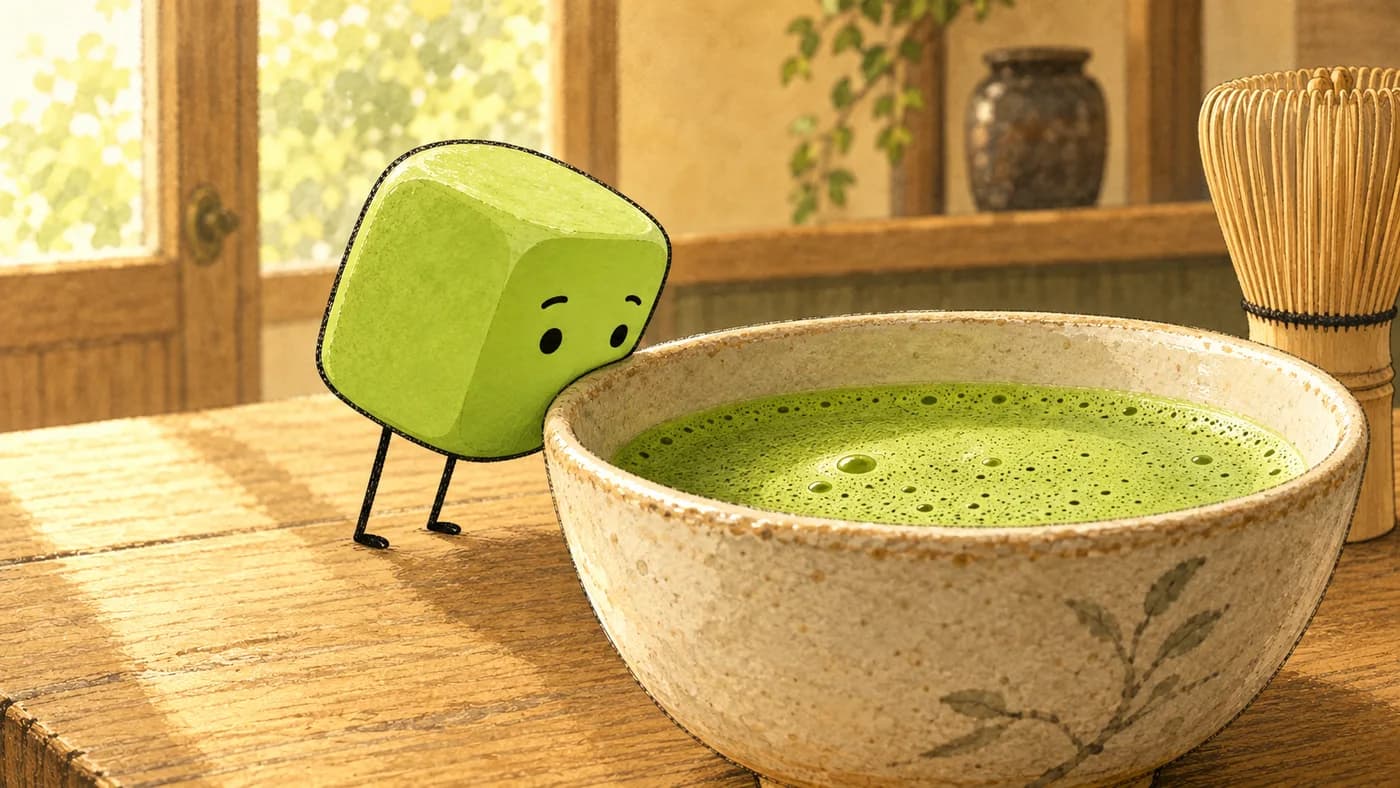
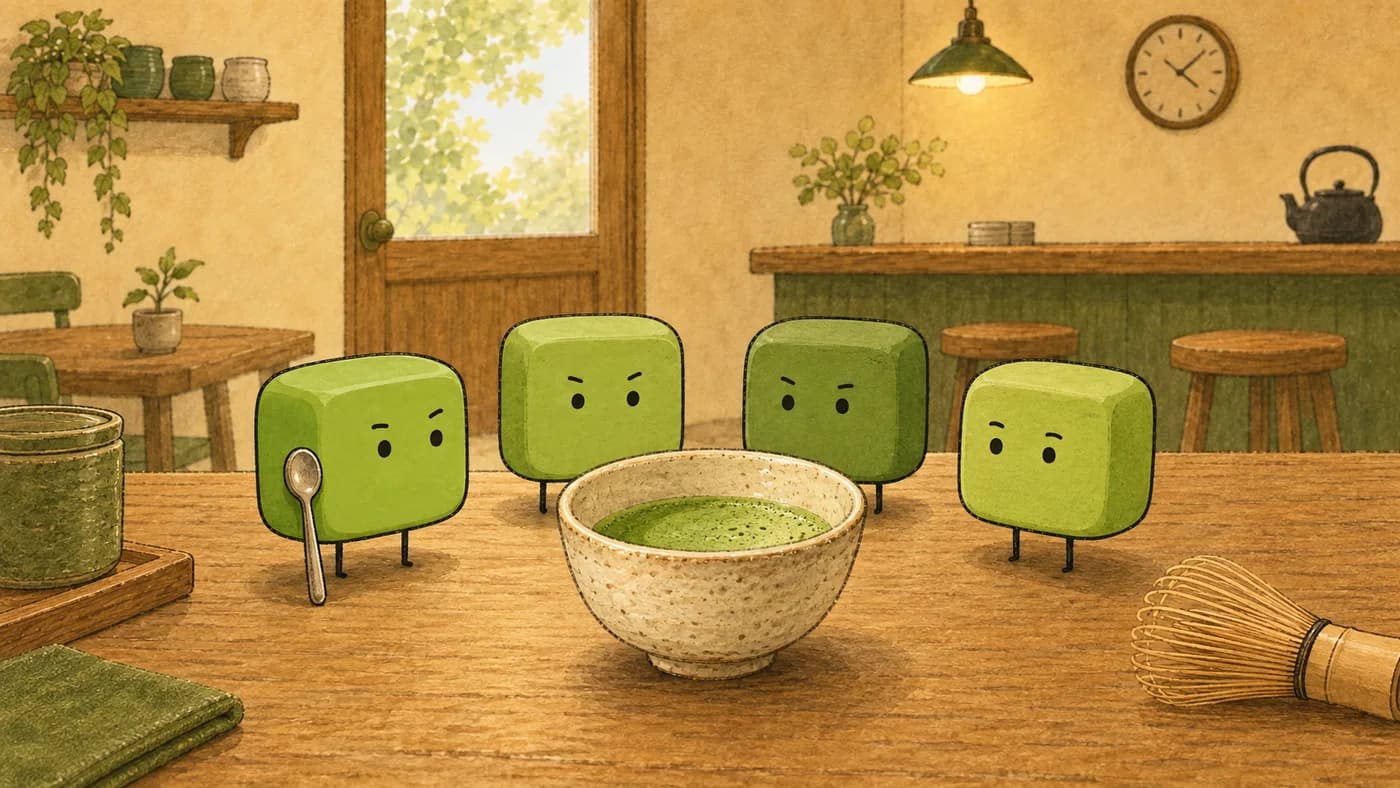
The Matji develop a testing protocol for foam before Mutjo has finished his first cup of the morning. It begins with one of them leaning so close to the bowl that its face nearly meets the surface. The other three arrange themselves behind it in a line. They look less like customers than a tribunal that has already read the evidence.
The first bowl has bubbles too large. A Matji gives one slow blink. Another turns its whole cube away by a fraction. There is no speech, but the decision is unmistakable. Mutjo studies the foam. Too coarse, he says.
The second bowl is thin. The smallest Matji lies flat on its back on the counter, overcome. Its two skinny legs point upwards with the exhausted drama of a gentleman fainting on a chaise longue. In England, people used to call this sort of display theatrical. They were usually the same people who had just been offered weak tea.
Mutjo starts again. The bowls gather along the counter: one, two, three, then several more. He warms each ceramic cup, measures the powder, and draws the bamboo whisk through the water with increasing concentration. The Matji lean forward. They rise onto their skinny legs. They settle back down. Their faces remain small and serious while the morning becomes a parade of almosts.
By the seventh bowl, Mutjo has stopped speaking. By the ninth, the kettle seems to have taken sides. The Matji inspect every surface. One watches the rim. One watches the centre. One watches the bubbles. The smallest watches Mutjo’s hands, perhaps to ensure that he does not take a shortcut. He would not. He is tired, not dishonest.
The tenth bowl is promising. Foam gathers in a fine pale-green skin, and one Matji begins to rise slightly from the counter. The verdict is not yet final. Mutjo’s face tightens. He whisks more gently, then more quickly, finding the narrow interval between force and care. The café fills with the soft rasp of bamboo and the faint steam of hot water.
He pauses to let the foam settle. Four pairs of black eyes remain fixed on the bowl. The pause becomes part of the test. Mutjo breathes out, adjusts the angle of the whisk, and resumes. It is not a grand performance. The best work rarely is.
The eleventh bowl is perfect. The foam is stiff, glossy, and quiet. It holds its shape without looking proud of itself.
For one second, the Matji remain still. Then all four bounce together. It is a small movement, but the joy in it is enormous. One rises higher than the others; another lands slightly sideways; the smallest turns its body as though applause requires a particular angle. Mutjo laughs once, surprised by the sound.
He takes a photograph of the bowl and tapes it to the wall beneath the lamp, using the same care one might give a diploma. The picture shows only the bowl, the whisk, and that immaculate surface. It is enough. The café has acquired its first certificate, awarded by four creatures who are incapable of writing and entirely capable of judgement.
The Matji do not celebrate the failed bowls. They simply record them in the only language available, with a blink, a tilt, or a solemn collapse. Mutjo begins to understand that their severity is a kind of trust. They would not inspect so closely if they did not believe he could improve the result.
When the eleventh bowl holds, Mutjo does not touch it at once. He lets the room look. The foam stays still. The four little judges remain still with it, and for that brief moment the shop feels perfectly balanced.
Two Matji nudge the corners of the photograph while the other two supervise. Mutjo watches them work. Straight, he says. They nudge again. Straighter. The smallest tilts its eyebrows. Mutjo bows. The photograph stays where it is, slightly more exact than before. Standards have been established. Mutjo has failed ten times and succeeded once. This is, in the life of a café, practically a triumph.