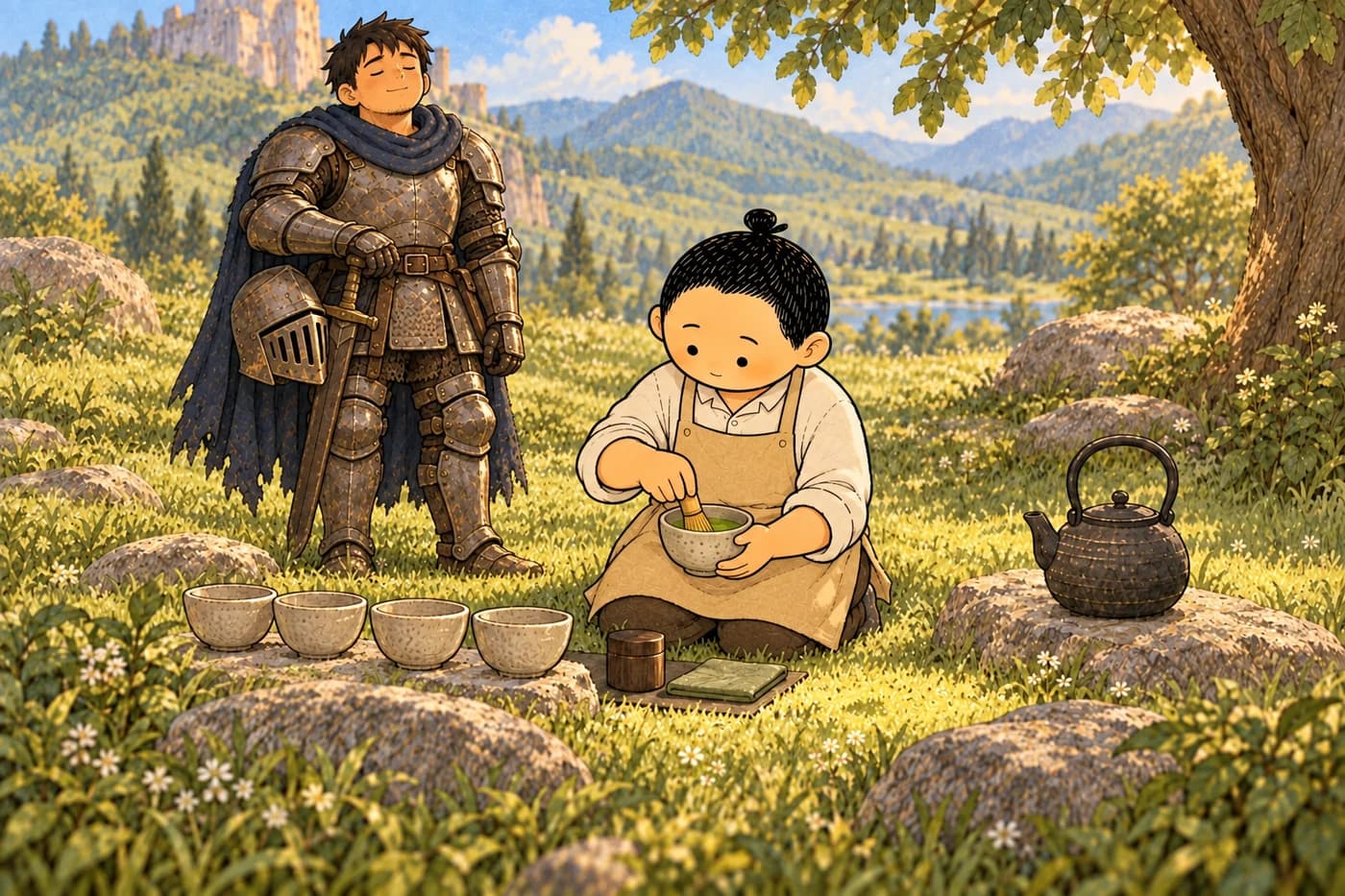
The first local they meet is a knight. Actual armour, actual sword, the entire arrangement. He stands at the edge of the grass with one gauntleted hand resting on the hilt and watches Mutjo whisk with the wary expression of a man who has been ambushed by stranger things. His horse is out of sight. His helmet is too large. The morning has not gone well for him either.
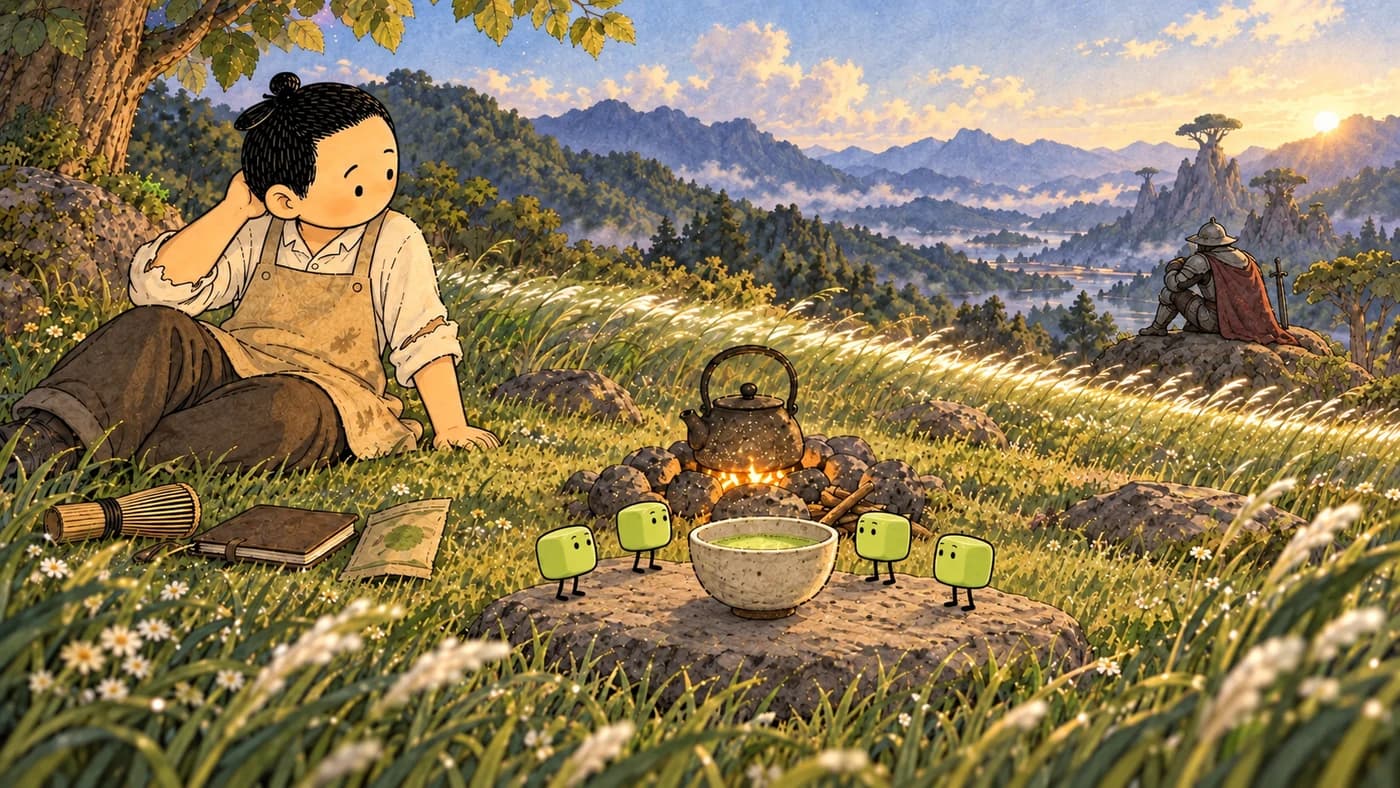
The Matji arrange themselves in a supportive semicircle around Mutjo. Presentation matters. Katjo faces the knight squarely. Itji leans towards the sword, then back towards the bowl. Yutju chooses a patch of sun between two stones. Dotjo settles beside the kettle so it cannot roll. Four tiny green cubes hold the arrangement through balance and steady attention, their two eyes and front eyebrows fixed on the guest with astonishing confidence in hospitality.
Mutjo bows. The knight bows back, though the helmet makes the movement several seconds longer than necessary. Mutjo lifts the bowl. He does not step forward. The knight does not step closer. Between them sits the distance required by caution, and inside it the smell of warm tea.
It’s tea, Mutjo says, offering the bowl with both hands. The knight looks at the surface. The foam is fine and glossy. A small leaf lands in it and remains upright. The knight removes his helmet. Beneath it is a tired face, wind-reddened and younger than the armour suggested. He studies Mutjo, then the Matji, then the green bowl again.
He drinks. There is a long pause, somewhere inside the helmet he has set on the grass. His eyes close. The hand on his sword relaxes. He sits down on the grass, armour and all, with the enormous staged creak of a man who has not properly sat down in years. The Matji watch this carefully. Itji leans towards the nearest knee plate and finds the metal warm from the morning sun.
The knight asks, quietly, whether there is more. Mutjo nods. There is. There always is. The Matji already have the kettle on. Dotjo presses against its base while Mutjo pours. Katjo inspects the second bowl. Yutju has moved closer to the knight’s boot, where a little heat remains. The knight watches them without touching. He seems to understand that small guests are not props.
His name is Sir Tetsu. He is travelling from the eastern road, though the road appears to have changed its mind several times. He has been awake since before dawn and has eaten nothing but a hard apple. Mutjo gives him rice as well. Sir Tetsu eats with the solemn gratitude of a person who has forgotten that breakfast may be kind.
He asks where the café is. Mutjo looks around at the grass, the hills, and the borrowed kettle. He cannot point to a door. The Matji all turn towards a low rise beyond the trees, then back to the bowls at their feet. They may not know the answer, but they seem to know where to go next. Sir Tetsu studies the rise, sets his helmet beside him, and waits for the kettle to sing again.
Sir Tetsu asks whether the tea has a name. Mutjo says matcha. The knight repeats it carefully, as if learning a password. Itji leans towards the bowl. Katjo watches the knight’s face. Yutju, already comfortable beside the boot, seems to have accepted him. The second cup disappears more quickly than the first, and the third is taken with a sigh that belongs to a man discovering he may rest without permission. Sir Tetsu sets the empty bowl beside the first, aligning their rims as carefully as shields. When Mutjo reaches for the kettle again, the knight shifts his sword farther into the grass and settles his boots. The third cup is no surrender; it is the first choice he has made without duty pressing behind it. By noon he has become the first regular of the new world. Mutjo lifts the kettle. The Matji lead on. The road, whatever it is, has acquired a tea service.