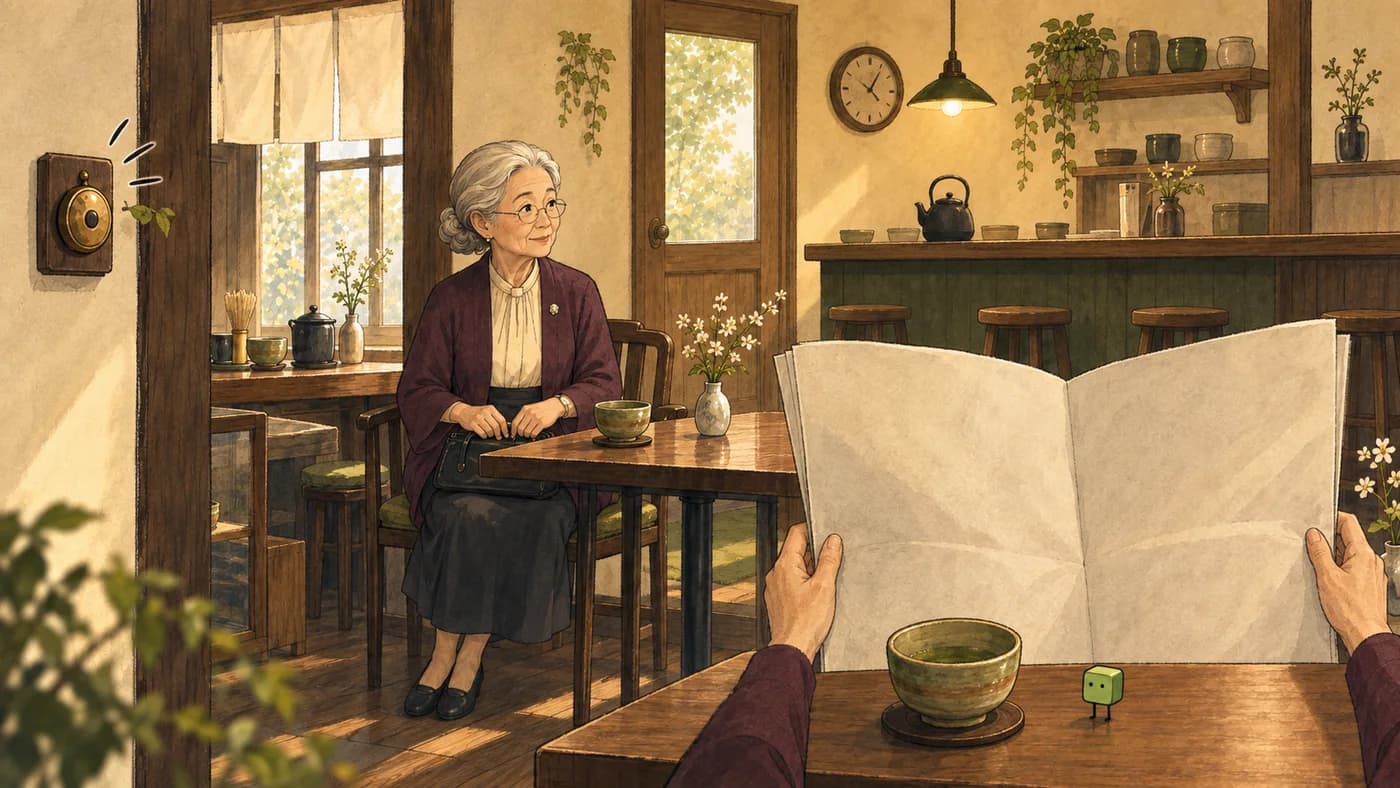
Hara-san comes in every Thursday, orders the same matcha and reads the same newspaper. She is the café’s entire regular clientele and its most dangerous observer.
Her arrival is part of the shop’s weather. The brass bell gives one note. Her shoes make two quiet sounds on the boards. Mutjo has the bowl ready before she reaches the window seat. Hara-san unfolds her paper, adjusts her round spectacles and settles into the page as though the rest of the room has been formally excused.
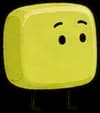
Four Matji watch from the counter. They have seen Hara-san before, but only from behind jars, bowls and the occasional fold of Mutjo’s apron. Today the smallest edges closer to her table. The others follow until all four are arranged behind the napkin holder.
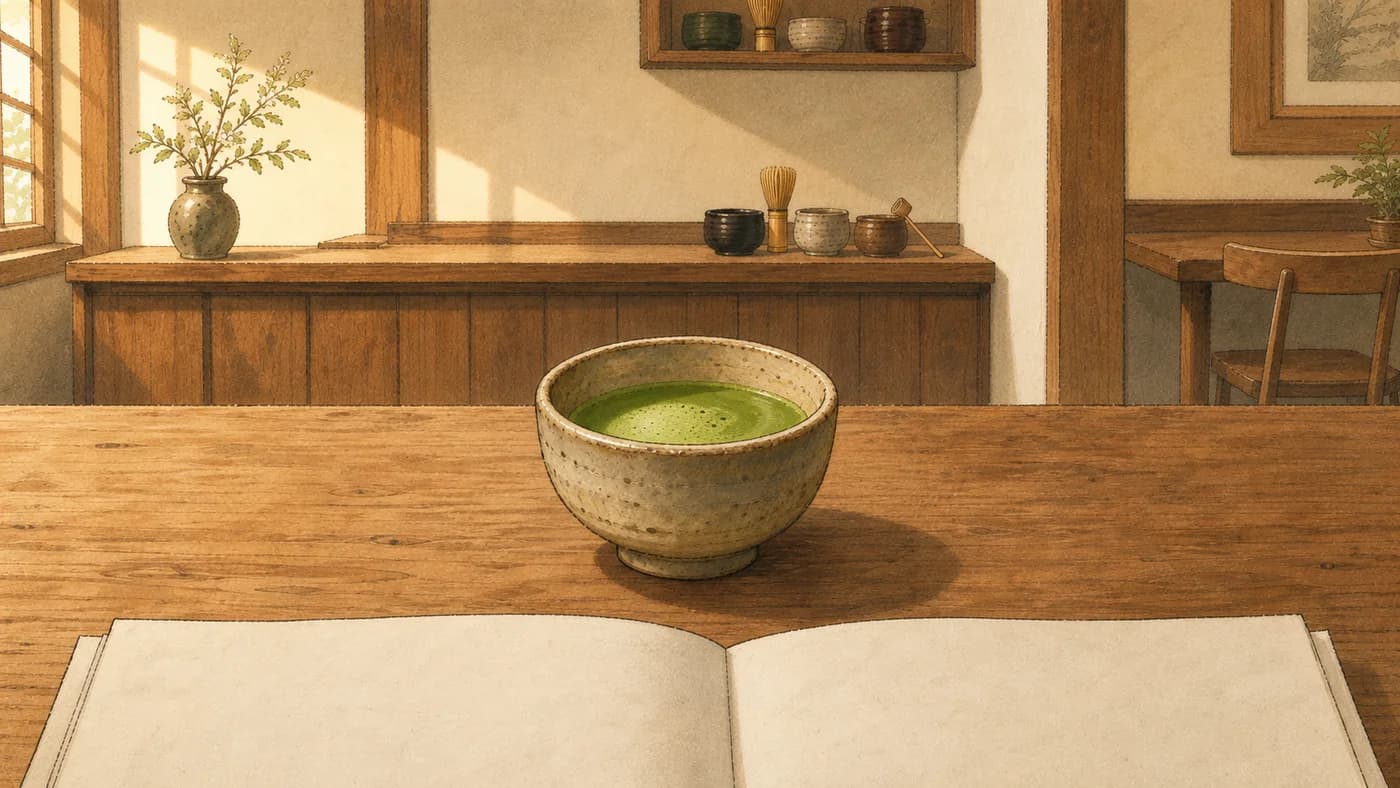
Hara-san drinks once and sets the cup in the centre of its saucer. Steam rises between her and the print. Nothing moves.
Then the saucer gives the faintest scrape.
Her eyes remain on the crossword. The cup has travelled two centimetres to the left. A green corner shows beside the napkin holder and disappears. The cup moves another two.
Mutjo sees the whole operation reflected in the window. One Matji leans against the saucer while another braces behind it. The other two supervise from cover. He considers intervening, then decides that anyone carrying out such a slow crime deserves the chance to complete it.
Hara-san turns a page. The paper crackles. Four green bodies freeze.
She lowers the newspaper by the width of one line. The Matji abandon the saucer and retreat in stages: one behind the sugar bowl, one beside a cup, two onto the counter. By the time the paper reaches the table, all four stand in a straight row with the fierce blank innocence of garden statues.
Hara-san looks at the cup, now plainly out of place. She looks at the row.
The smallest Matji has chosen a difficult pose. One skinny leg is lifted; the other supports its whole square body. Its two eyebrows are arranged in an expression of such strenuous harmlessness that Mutjo must look at the kettle.
Hara-san studies each face. One Matji’s eyes shift towards the saucer. Another leans by a fraction before correcting itself. The room grows quiet enough for the wall clock to sound argumentative. The kettle answers with a small click, but nobody grants it the authority to interrupt the hearing.
Mutjo holds the kettle cloth and waits. He could offer an explanation, but Hara-san has never needed help reaching a conclusion. At last she raises the cup, finishes the matcha and places it precisely where the Matji moved it.
She folds the newspaper into its usual square and gathers her handbag. The four statues remain upright while she crosses the room. At the door she pauses.
“Tell the little ones the foam was excellent today.”
Mutjo bows. Behind him, four small bodies tilt together. Relief moves through the row like a breeze across grass.
Hara-san steps into the street. Her reflection lingers in the glass with one eyebrow raised. The smallest Matji lowers its leg and turns towards the empty table. The cup is no longer evidence of danger. It is proof of an agreement that nobody has had to explain.
Before the next Thursday, Mutjo places a fresh napkin beside the sugar bowl. Hara-san notices it when she sits down. So do the Matji. The napkin becomes a quiet boundary: a cup may travel within it, provided everyone is prepared to pretend that cups sometimes move themselves.
The newspaper opens. Mutjo serves the matcha. Four green corners appear behind the holder, and Hara-san begins the crossword with the composed expression of a customer who sees everything and intends to remain pleasantly surprised.