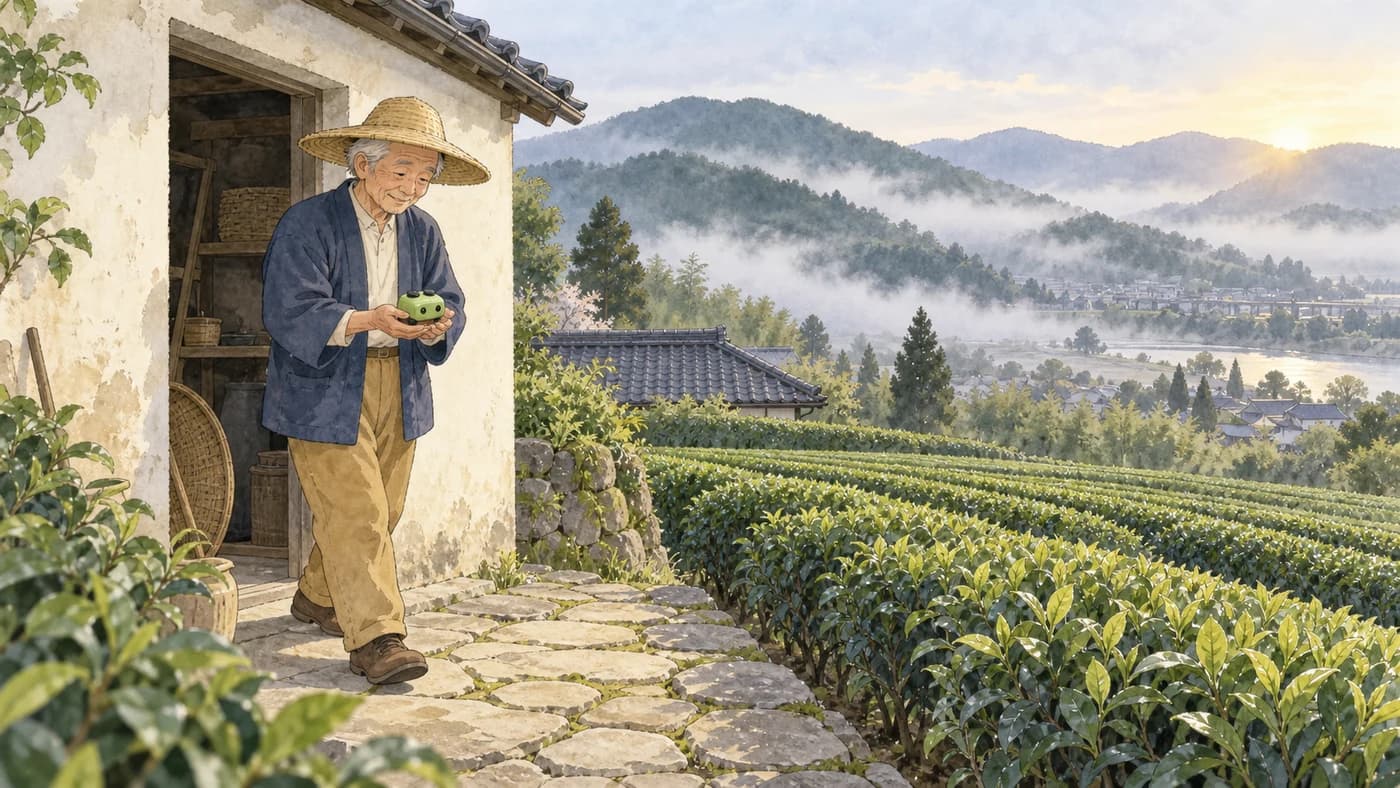
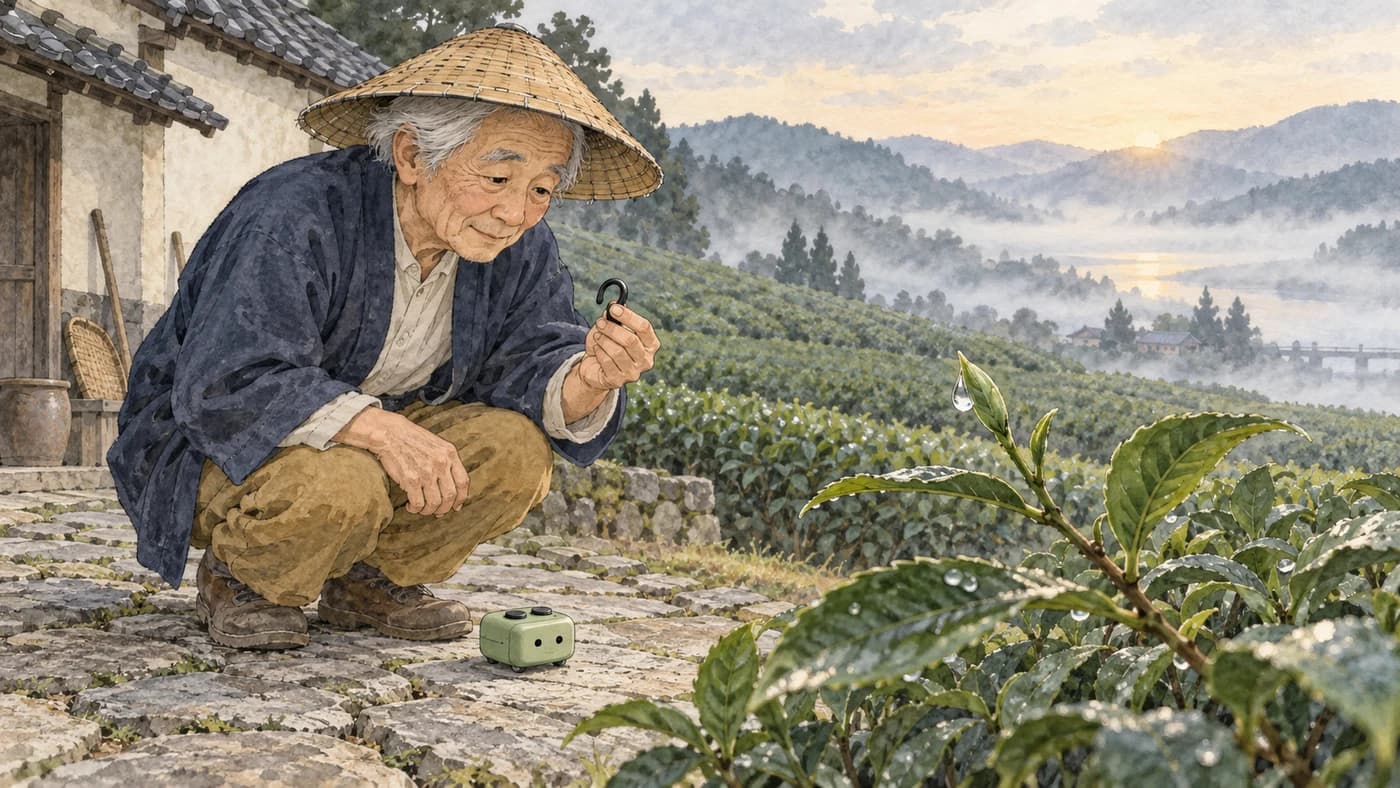
On a pale morning in Uji, the farmer carried Botji from the cream-plastered shed and set it on the dry paving beside the tea rows. Beyond the dark tiled roof, the gentle hills were still wearing ribbons of mist. Cool grey lingered in the paving joints, while the first light touched the upper leaves.
The farmer’s silver hair shone beneath a straw hat. The familiar indigo jacket, ivory shirt and ochre trousers made a patch of quiet colour among all the green. Before they began talking, the farmer chose to put on the small charcoal ear-hook. Botji’s longer words travelled privately through it; only its tiny public sounds were spoken aloud.
At the end of a low branch was a tight new bud. Its folded tip pointed past Botji toward the mist, and one clear drop sat in the pale seam.
“It is very small,” Botji said.
“So are you,” said the farmer.
Botji’s whole body made an offended little pivot. The farmer’s brown shoes remained respectfully still.
“I am precisely five centimetres wide.”
“Then you have the advantage of precision.”
They looked at the bud together. Botji noted its folded shape, the pale seam along one edge and the way it held the drop of morning water without opening for it.
“When will it grow?”
“I don’t know exactly.”
Botji waited nine seconds. The drop trembled when the branch moved, but the bud stayed folded.
“It may be having difficulty.”
The farmer crouched, hands away from the plant. “Or it may be taking its own time.”
On each morning that followed, the farmer chose the ear-hook again before their longer conversation.
The next morning, the farmer brought Botji to the same dry place. The air was clearer, and the bud looked almost the same.
“No progress,” Botji said.
“What else changed?”
Botji looked beyond size. Yesterday’s drop was gone. The branch cast a shorter shadow. A thread of spider silk, empty and bright, trembled between two twigs.
“Several things changed. The bud did not.”
“That is a better answer.”
On the third morning, soft rain tapped the roof tiles. Botji stayed dry under the shed eave on a stable low table while the farmer stood nearby, hat beaded with water. The bud was visible across the narrow paved strip, blurred now and then by rain. Drops gathered at its folded tip and slipped into the dark soil below.
“Today I cannot compare the seam properly.”
“Then today we know less.”
Botji considered this. It had expected patience to produce more answers, not fewer.
On the fourth morning, the farmer carried Botji back to the path. Sunlight reached under the branch. The bud’s pale seam had widened—perhaps by less than the width of a grain of rice. Botji checked twice.
“It changed.”
“Yes.”
“Was it waiting for Thursday?”
The farmer laughed, a warm sound under the straw hat. “I don’t think the bud keeps our calendar.”
This time Botji let the question of finishing rest. It named what was present: a softer edge, a deeper green near the stem, a shadow where the fold had loosened. Then it stopped naming and looked.
Two days later, the bud had opened into a small new leaf. Its surface caught the pale morning, still faintly creased from the fold. Botji faced it in complete attention, while the farmer leaned closer beside the paving.
“Oh,” Botji said aloud.
“Worth the wait?” the farmer asked.
Through the private ear-hook, Botji answered, “The waiting was also where the learning happened.”
The farmer took off the ear-hook, and they shared the rest without words: a new leaf keeping its own time, a tiny robot learning that slowness carried changes worth seeing, and the green hills emerging as the mist lifted.