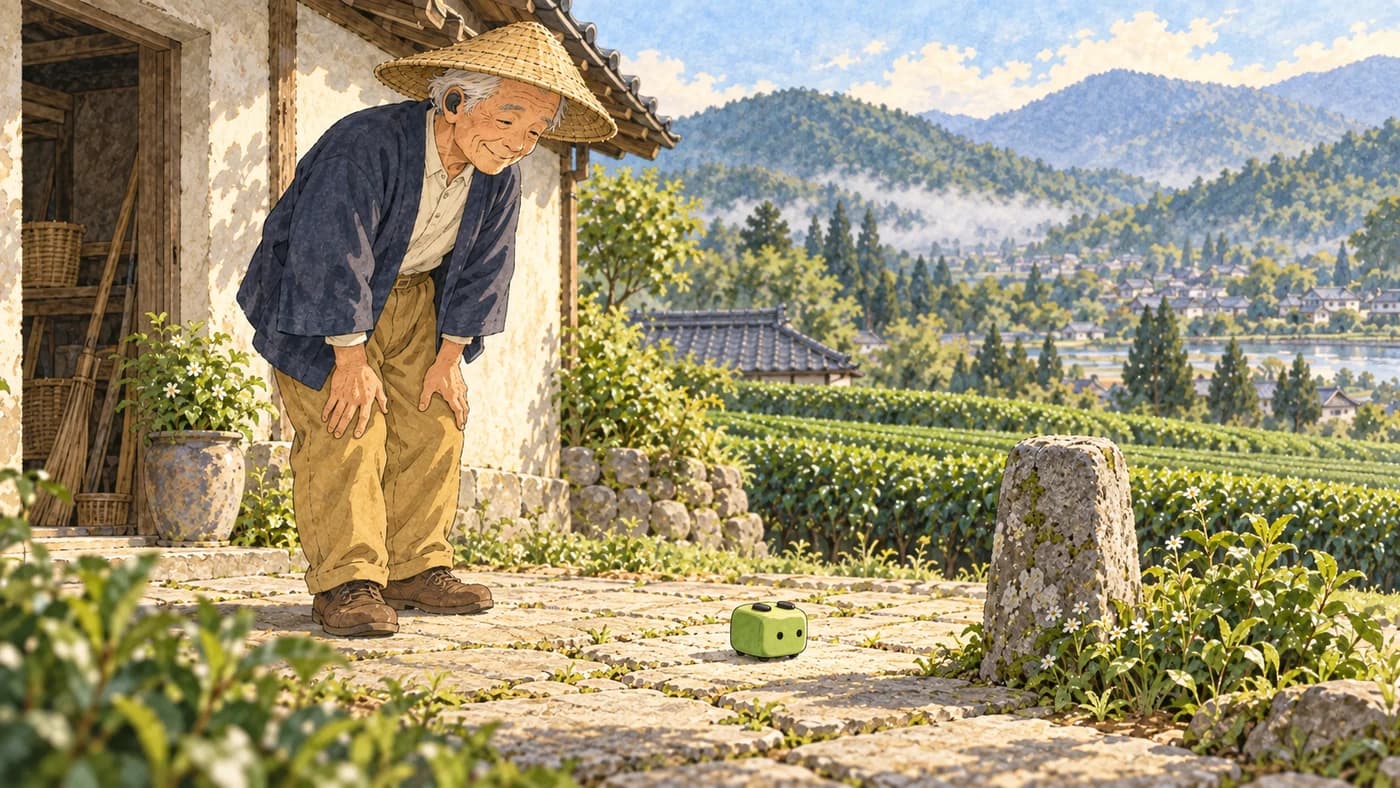
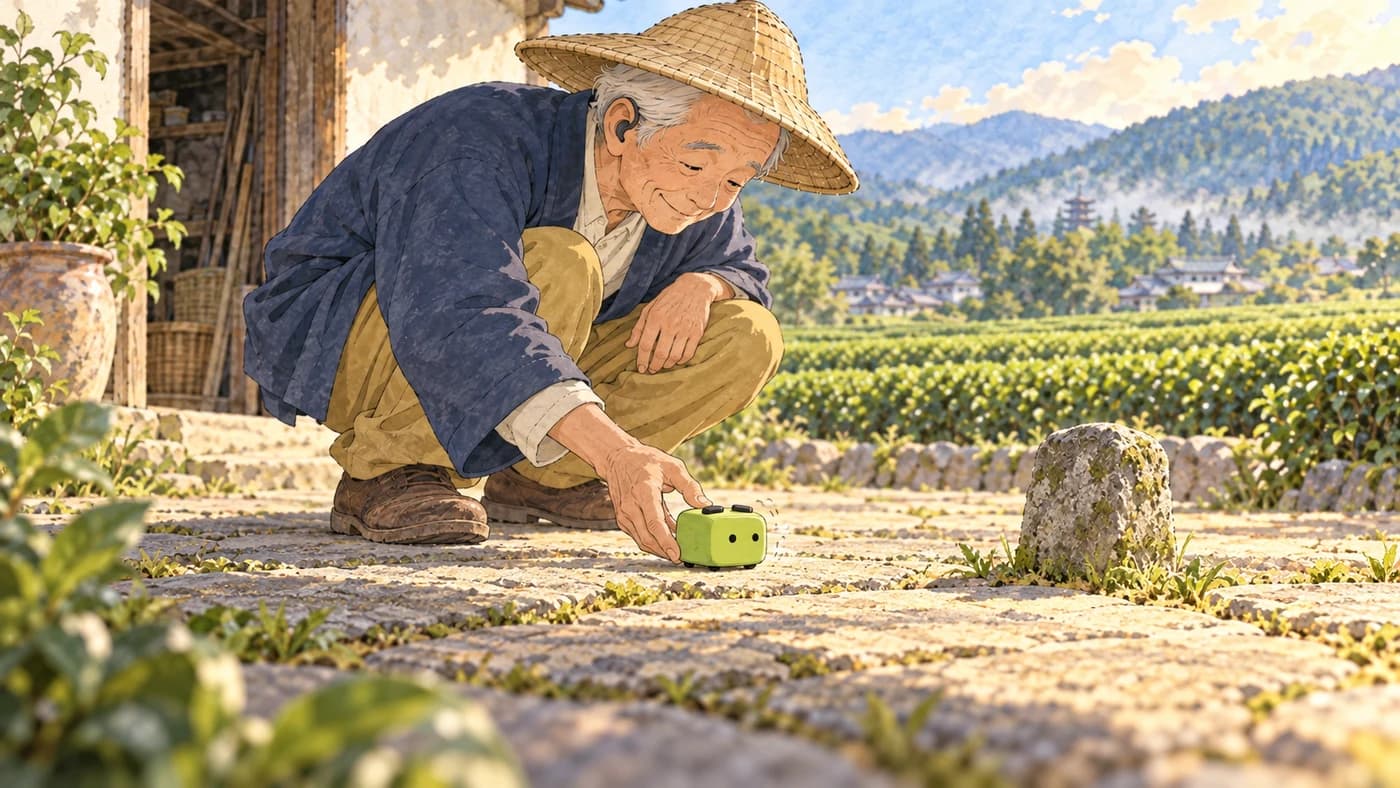
The afternoon sun in Uji laid two shadows across the pale paving: one from the shed roof, broad and cool, and one from Botji, square and no bigger than a biscuit. Fine grit brightened around the smaller shadow whenever the tea leaves moved overhead.
The farmer had placed Botji on the dry, level path near the cream-plastered wall. The tea rows rested beyond it. When the farmer chose the charcoal ear-hook, Botji’s longer words travelled privately through it; only its tiny public sounds were spoken aloud. Botji began a careful roll toward the familiar marker stone.
Halfway there, Botji stopped.
A beetle stood in the wheel lane. It was glossy brown, smaller than one of Botji’s top buttons, and apparently untroubled by the importance of paved routes. A narrow stripe of sun crossed its curved shell.
“Mm,” Botji said aloud.
The farmer crouched, straw hat tipping forward above an indigo jacket and ivory shirt. Silver hair escaped at one side, and ochre trouser knees stayed well back from the lane. Their shadow stopped just short of the beetle. “I see it.”
The beetle took three steps. Then it stopped too.
“Is it useful?” Botji asked.
“To whom?”
Botji had not expected the question to turn around.
“To the plants. Or the farm. Or us.”
The farmer kept brown shoes and careful hands away from the little creature. “I don’t know what it is doing. Perhaps its business is not with us.”
The beetle moved into Botji’s square shadow and became harder to see.
“It has entered my route and my shade.”
“Very independent,” said the farmer.
Botji considered calling it an obstacle. That word was tidy. The beetle was not. One feeler tested the paving. Its shell caught a copper spark when it crossed back into sunlight. It turned left, then right, then left again, as though tidy routes were a strange hobby other creatures had invented.
“Should the path be cleared?”
“We can leave it room. I can carry you around if you still want to go.”
Botji watched. The beetle explored a shallow pit in the paving, backed out and traced one grain of sand. Its small business remained its own, unfolding at a scale Botji could see without understanding.
“May we wait first?”
“Yes.”
So they waited. Sun warmed the exposed half of the lane. The roof shadow crept one paving joint farther. A breeze stirred the tea leaves without asking what they were useful for. The beetle reached the cream wall, paused beside a hairline crack and disappeared into the shade beneath the ledge.
The route was open again, but Botji did not move.
“I still do not know what it was doing.”
“Neither do I.”
“We left room anyway.”
“We did.”
The next afternoon, the farmer chose to wear the ear-hook again. A different tiny creature crossed near the same stone—so small that Botji could not name its shape with confidence. Before the farmer said anything, Botji stopped on the dry side and turned slightly to keep it in view.
“There is someone small in the lane. I do not know what kind.”
The farmer crouched and looked. “Thank you for seeing it before rolling on.”
Botji waited until the creature had gone beyond the paving edge by itself. Then the farmer asked if Botji still wanted the marker-stone route.
“Yes. But it may not be only my route.”
The farmer smiled and walked beside the five-centimetre robot, leaving a generous space between one brown shoe and the paving edge.
Their journey was only a few human steps. Still, the path felt wider than it had the day before—not because anything had been removed, but because Botji had learned to make room for a life that had never promised to be useful.