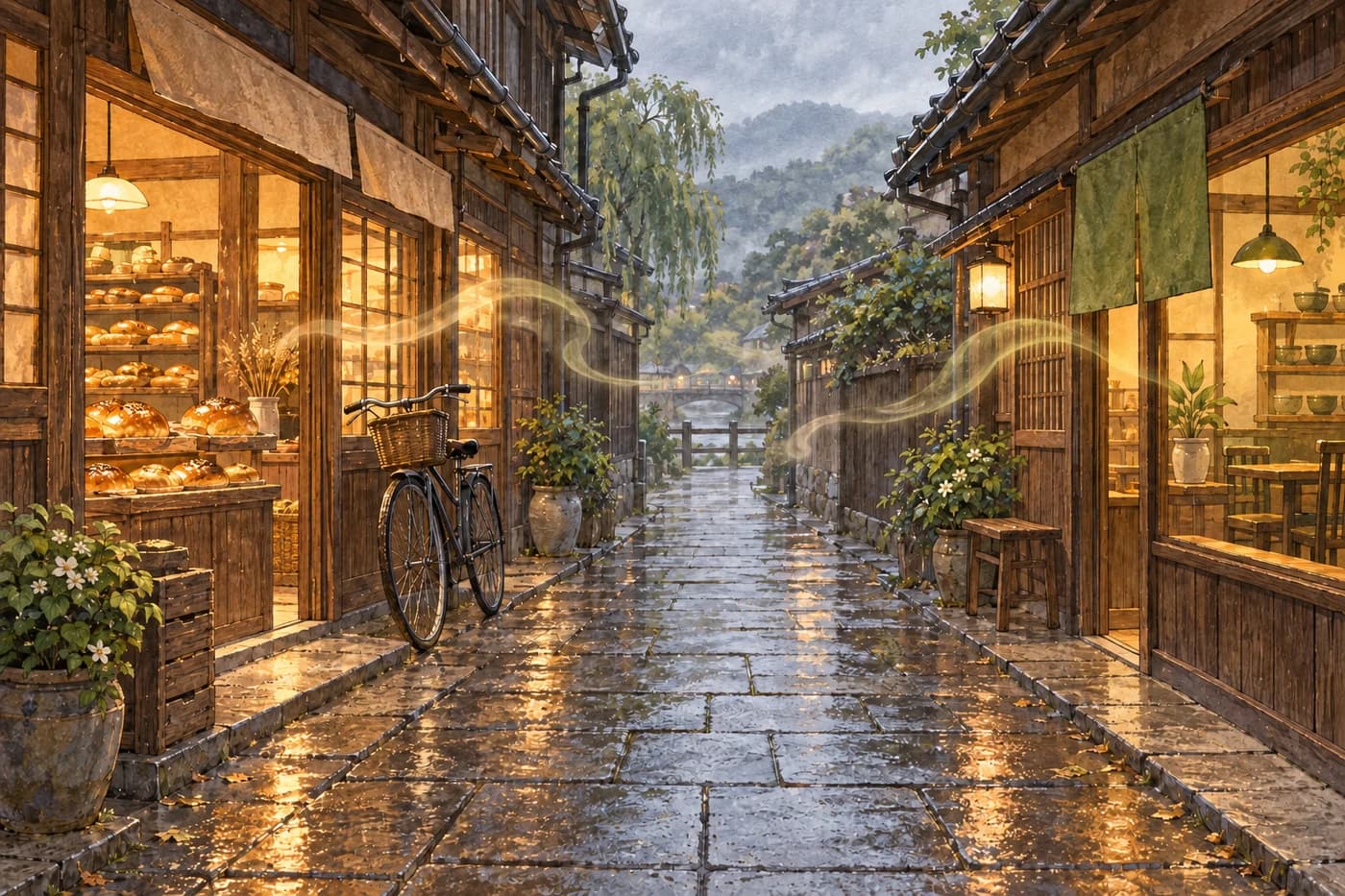
Every morning two smells argue over our street: fresh bread from Ume-san’s bakery and fresh matcha from Mutjo’s café. The neighbourhood has learned to walk down the middle and breathe deeply. On damp days the aromas gather beneath the eaves, sweet and grassy together, while the first bicycles pass through them as though entering a particularly delicious weather system.
Ume-san starts the contest. She is quick, floury, generous, and competitive in the way of a person who can tell from across the lane whether someone else’s oven is running too hot. One Tuesday a tray of anpan appears on the café counter, covered with a clean cloth and a card reading FOR PROFESSIONAL REVIEW. The Matji gather in a row. Their eyebrows rise. The tray does not survive.
Mutjo studies the empty plate. He asks no questions. He warms a bowl, measures the powder, and makes a cup with the patient seriousness he brings to all difficult conversations. Then he fills a small flask and sends the Matji to the bakery. They travel in pairs, pressing their soft bodies against the flask as their skinny black legs find each seam in the paving. At the kerb they pause, change sides, and continue. The flask arrives upright, which is all anyone needs to know about their standards.
For a week the bakery doors close at odd hours. Green dust appears on the flour board. A whisk is seen beside the cooling rack. Ume-san rejects three batches of dough, then keeps one on the windowsill to judge it by smell. The Matji run reconnaissance between the two shops, emerging alternately powdered white and green. One sits on a sack of flour as if guarding a mountain pass. Another falls asleep beside a bowl of proving dough and wakes with a little crescent of flour along its edge.
The street begins to speculate. Hara-san suggests a treaty. Ito-san says there is no applicable regulation for pastry diplomacy. Kobayashi-san offers a tofu mould, which nobody understands but everybody accepts. Mutjo says only that they are trying something. Ume-san says that trying something is not the same as getting it right. Then she smiles, because the next tray has finally risen evenly.
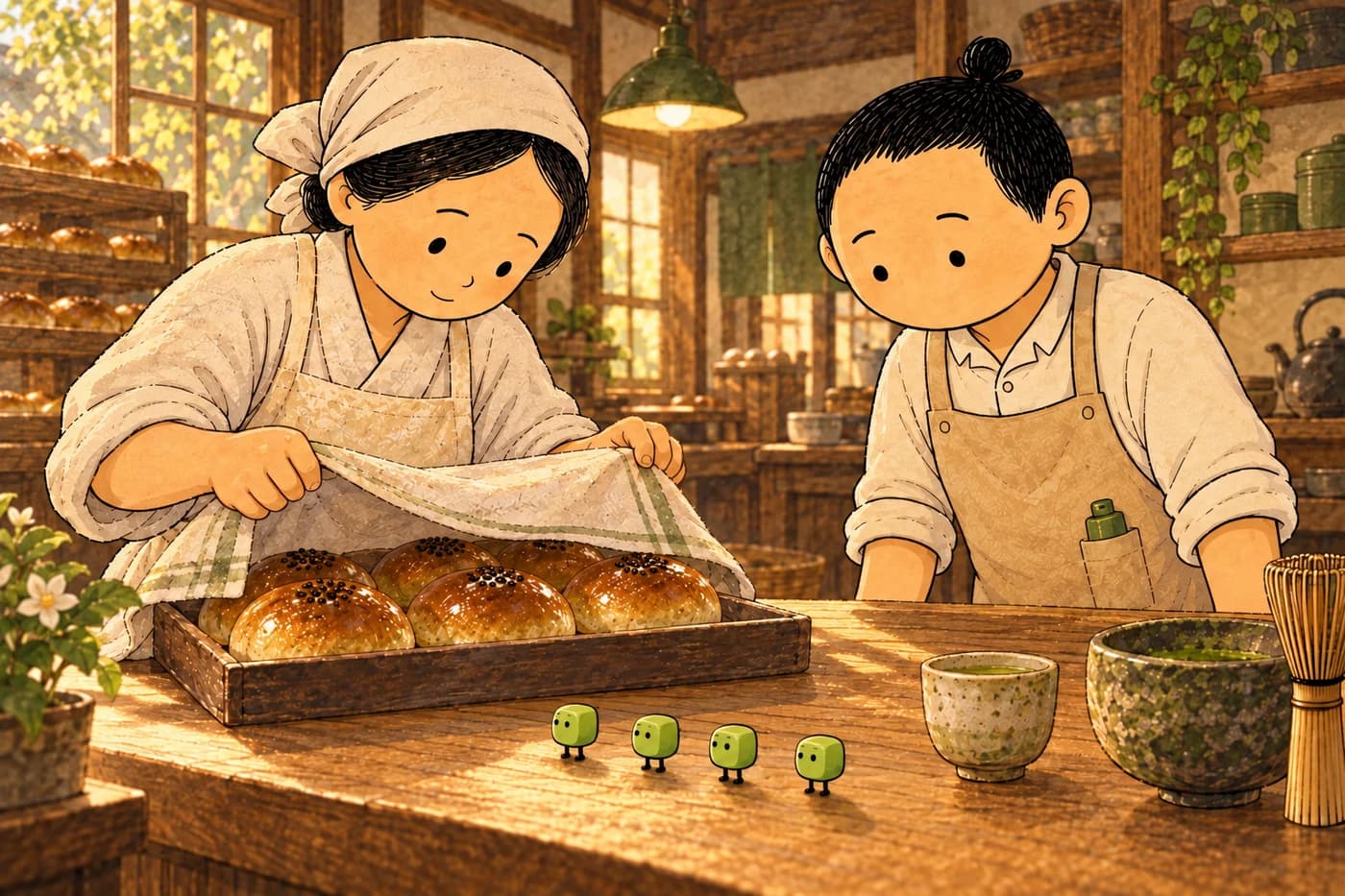
The result appears on both counters the same morning: matcha anpan, her bread and his tea, a joint operation with two signatures on the little card. The buns are round and glossy, their red-bean centres tucked beneath a green-tinted crumb. Mutjo’s matcha is present without becoming bossy. Ume-san’s bread is soft without becoming sentimental. The Matji sit beneath the card and inspect the first batch as though they have been appointed judges by a committee of very small experts.
The queue forms in the middle of the street, precisely where the smells used to argue. A student buys two. Yuki-san buys six for the bathhouse staff. Ito-san purchases one for evidence and eats it before reaching the post. The baker pretends not to notice. The queue bends around the drain, and every time the bakery door opens, the warm scent of bean paste moves through it. Mutjo refills the street flask. Ume-san slides another tray from the oven. Neither shop can now claim where one fragrance ends and the other begins.
Ume-san cuts one bun open for the Matji, placing pieces on a saucer so they can lean close without tumbling into the filling. They inspect the crumb, bean paste, and faint green edge. Mutjo waits. Katjo gives one solemn nod. Ume-san accepts it as the highest possible review and writes the result in her order book. By afternoon the tray is empty. Ume-san and Mutjo add another card, this one saying TOMORROW AS WELL. The Matji lean against the bakery door in contented exhaustion, their green sides dusted with flour. The two smells no longer argue. They travel together down the lane, and I have stood in that lane myself twice, purely for the company and perhaps one more bun.