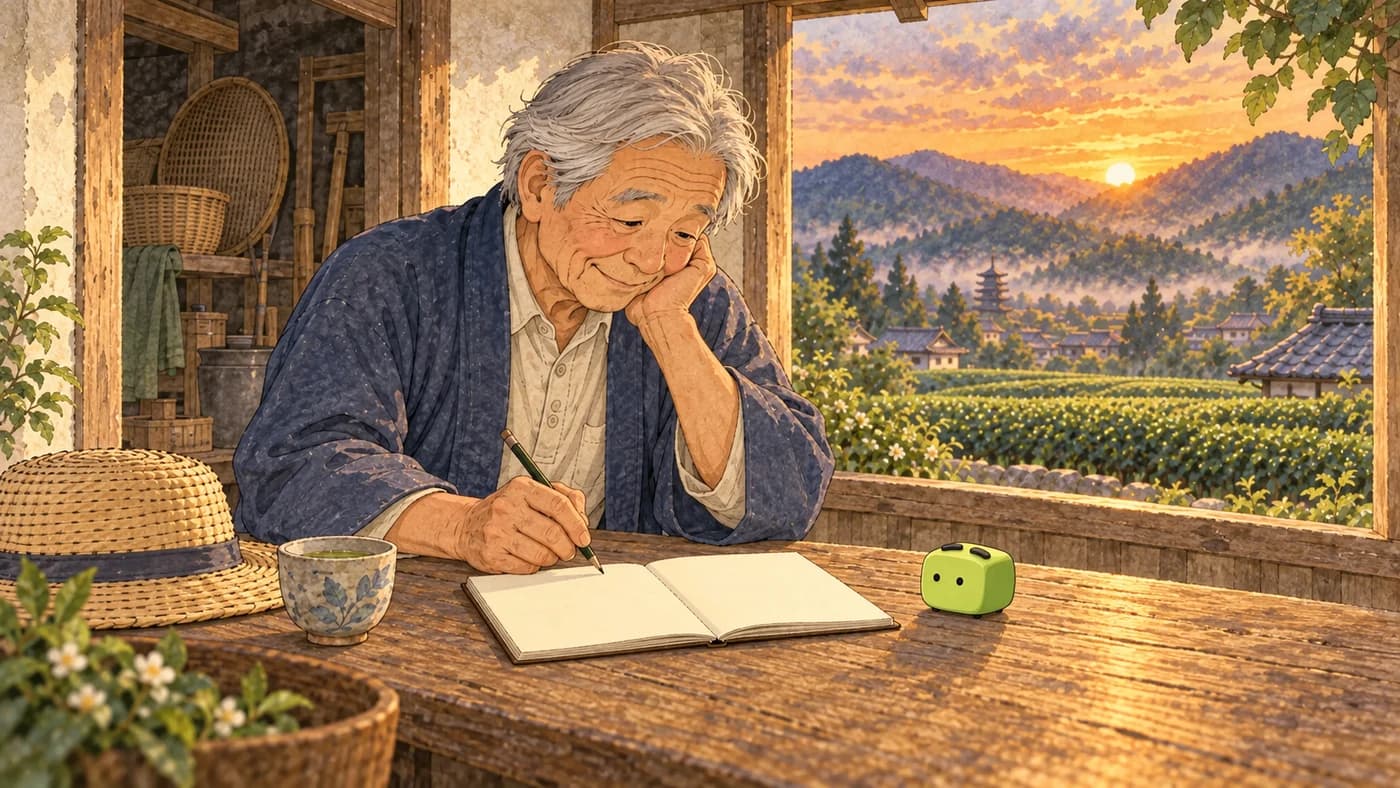
Each evening before tea, the farmer sat at a small table beneath the shed window. The straw hat came off, showing silver hair above the familiar indigo jacket, ivory shirt, ochre trousers and brown shoes. A plain notebook waited on the table for one thing from the day worth remembering.
Botji liked this routine immediately. One thing was an admirably precise quantity.
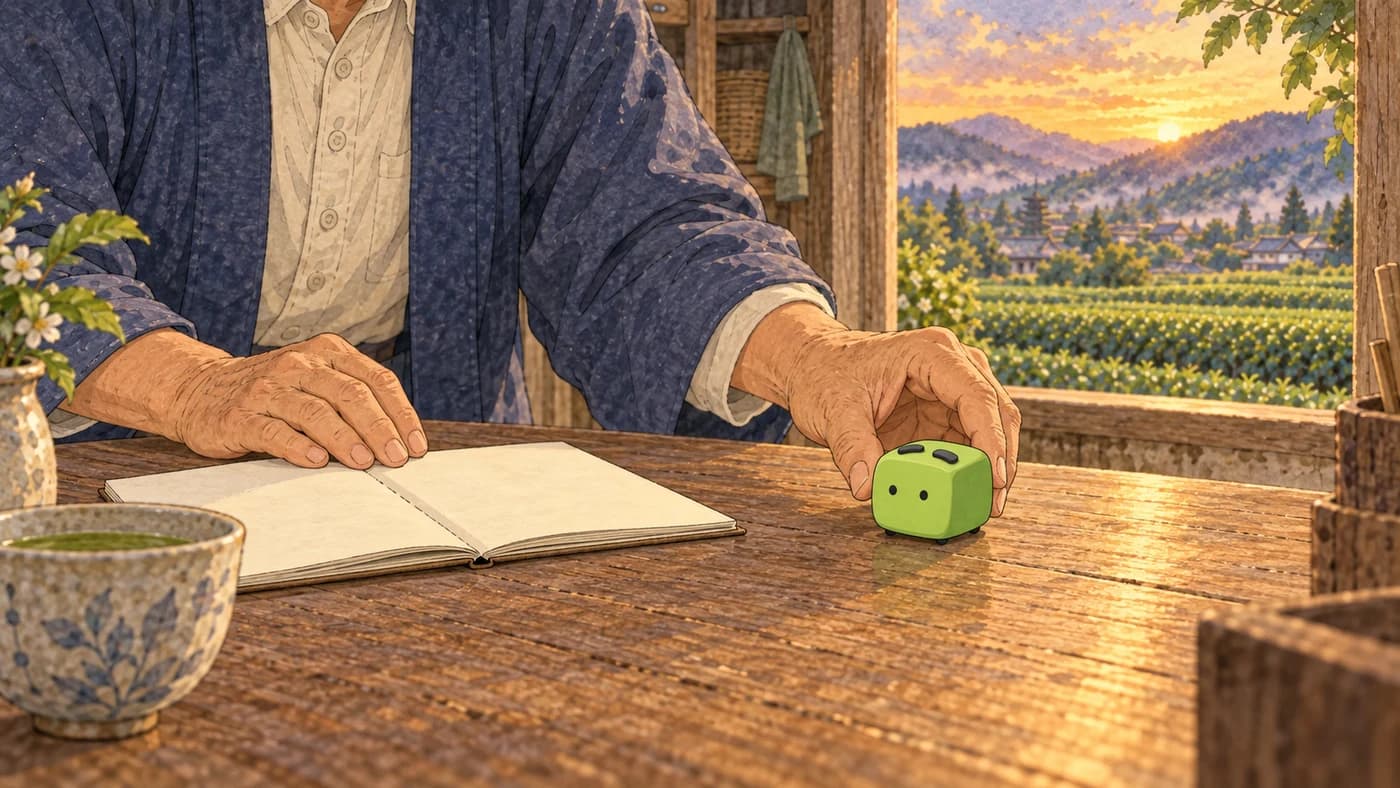
The farmer placed Botji on the dry, stable tabletop, well back from the edge, then put on the charcoal ear-hook. Botji’s longer words travelled privately through it; only its tiny public sounds were spoken aloud. Outside, late light warmed the cream plaster. The dark roof tiles ticked softly as they cooled.
“I have prepared today’s entry,” Botji said.
“Have you?” The farmer opened the notebook.
Botji began with the morning shadow beside the north wall. Then came four pale clouds, a loose straw on the paving, the farmer’s left shoelace being tied twice, eleven drops falling from the eave after the rain had ended, and a small bird that had landed on the roof.
The farmer’s pencil waited above the page.
“That is more than one thing.”
“They are all eligible.”
“My little routine is not an inventory. I choose what I want to keep.”
Botji went still. It had remembered the routine and somehow misplaced the farmer.
“Then how may I help?”
“You could ask what mattered to me.”
So Botji asked.
The farmer looked through the window toward the rows. “The breeze stopped at noon. For a moment, everything was quiet enough to hear water somewhere beyond the wall.”
“I noticed the quiet. I did not know that was the part you would keep.”
The farmer wrote one sentence. The rest of Botji’s excellent inventory remained unwritten and, to Botji’s surprise, the notebook did not seem offended.
The next evening, the farmer came in tired and set the closed notebook on the table. Botji waited until the farmer had settled and chosen the ear-hook.
“Would you like your one thing tonight, or would you rather leave the page empty?”
The farmer smiled. “I would like it. Did you notice something?”
“Three small birds landed on the dark tiles when the sun returned.”
The farmer glanced up. “Two birds. The third dark shape was a curled leaf caught near the gutter.”
Botji replayed the moment without pretending certainty. “Two birds and one leaf. Thank you for correcting me.”
“And thank you for remembering the notebook.”
Before the farmer wrote, an elderly neighbour paused at the open shed door. The farmer greeted them. They admired the amber evening on the wet paving, then began to go.
Botji turned toward the farmer. The neighbour could not hear the private channel.
“Would you like to ask what they would keep?”
The farmer looked pleased. “Wait—what was one thing worth remembering from your day?”
The neighbour considered. “Your laugh, just now. I had not heard it this week.”
The farmer laughed again, softer this time, and wrote that answer instead. Then the notebook was turned so the neighbour could add a small line of their own. Human hands passed the pencil. Botji stayed where it was, listening.
The page held two kinds of gratitude: being remembered, and being asked.
Botji had not chosen the farmer’s memory, corrected the farmer’s work or replaced anyone’s voice. It had noticed a routine, accepted a correction and helped make room for the next person’s knowledge.
When the farmer finally closed the notebook, Botji said, “Oh,” aloud.
“What is it?” asked the farmer.
With the ear-hook still worn, Botji answered privately, “One thing can become larger when it is shared.”
Outside, the gentle Uji hills darkened beyond the rows. Inside, the notebook rested between farmer and neighbour, with plenty of empty pages left for things nobody had noticed yet.