The shop gets busy — new-world busy, queue-out-the-door busy — and four Matji, whatever their opinion on the matter, are not enough helpers. The villagers arrive before sunrise. Sir Tetsu has begun taking reservations on a slate. The singing fruit sends customers across the square. Even the mushrooms appear at the window, though nobody can tell whether they are ordering or reporting. Mutjo keeps whisking. The kettle keeps boiling.
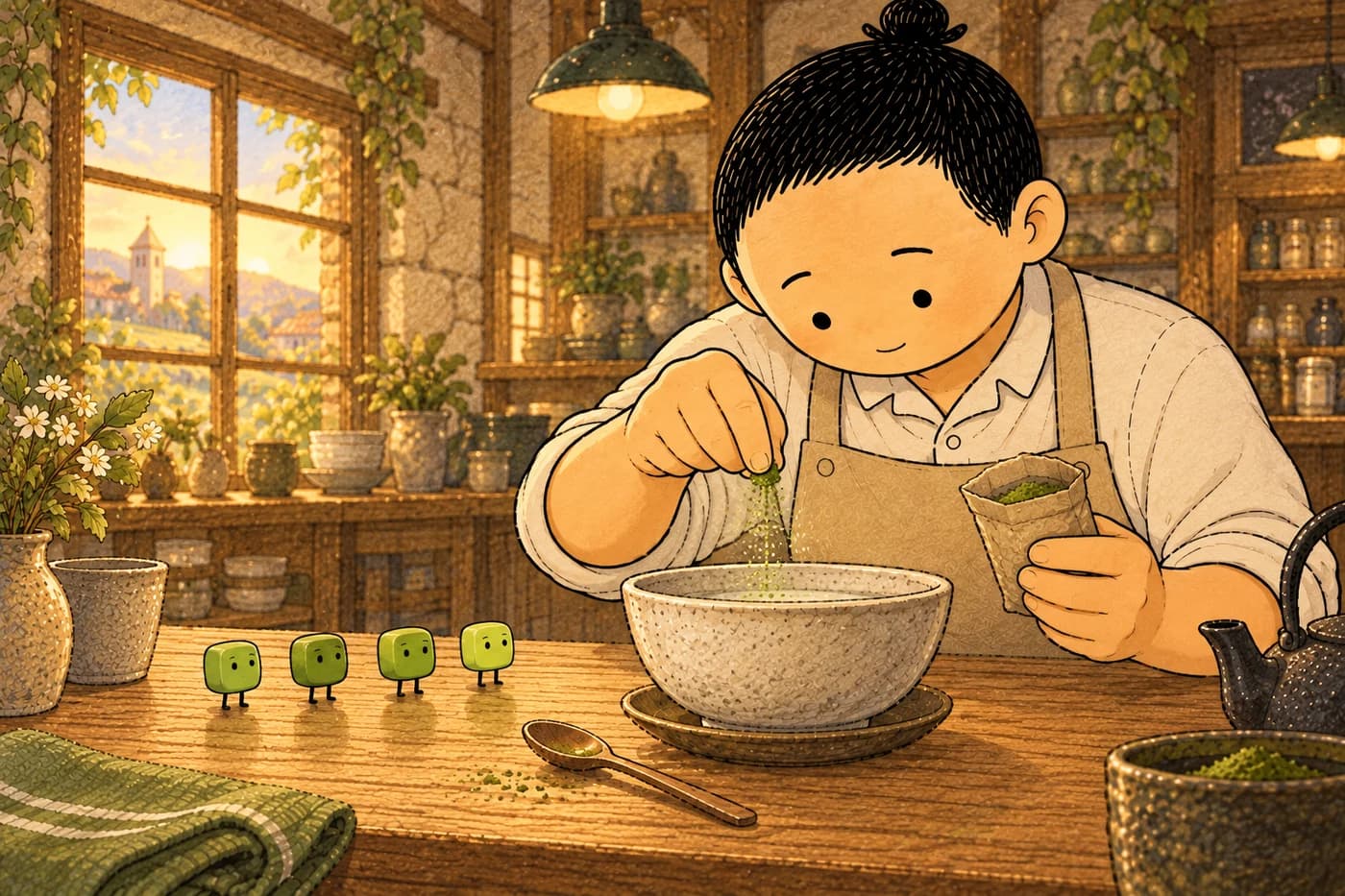
One quiet morning he does the thing he has only done once before, and then by accident. He clears the back table. He warms a fresh bowl. He opens the little packet of mysterious green powder and measures a careful pinch. The powder clings together in soft grains, greener at the centre than the edge. Mutjo holds his breath. The original four gather in a formal line. Their eyes do not leave the bowl.
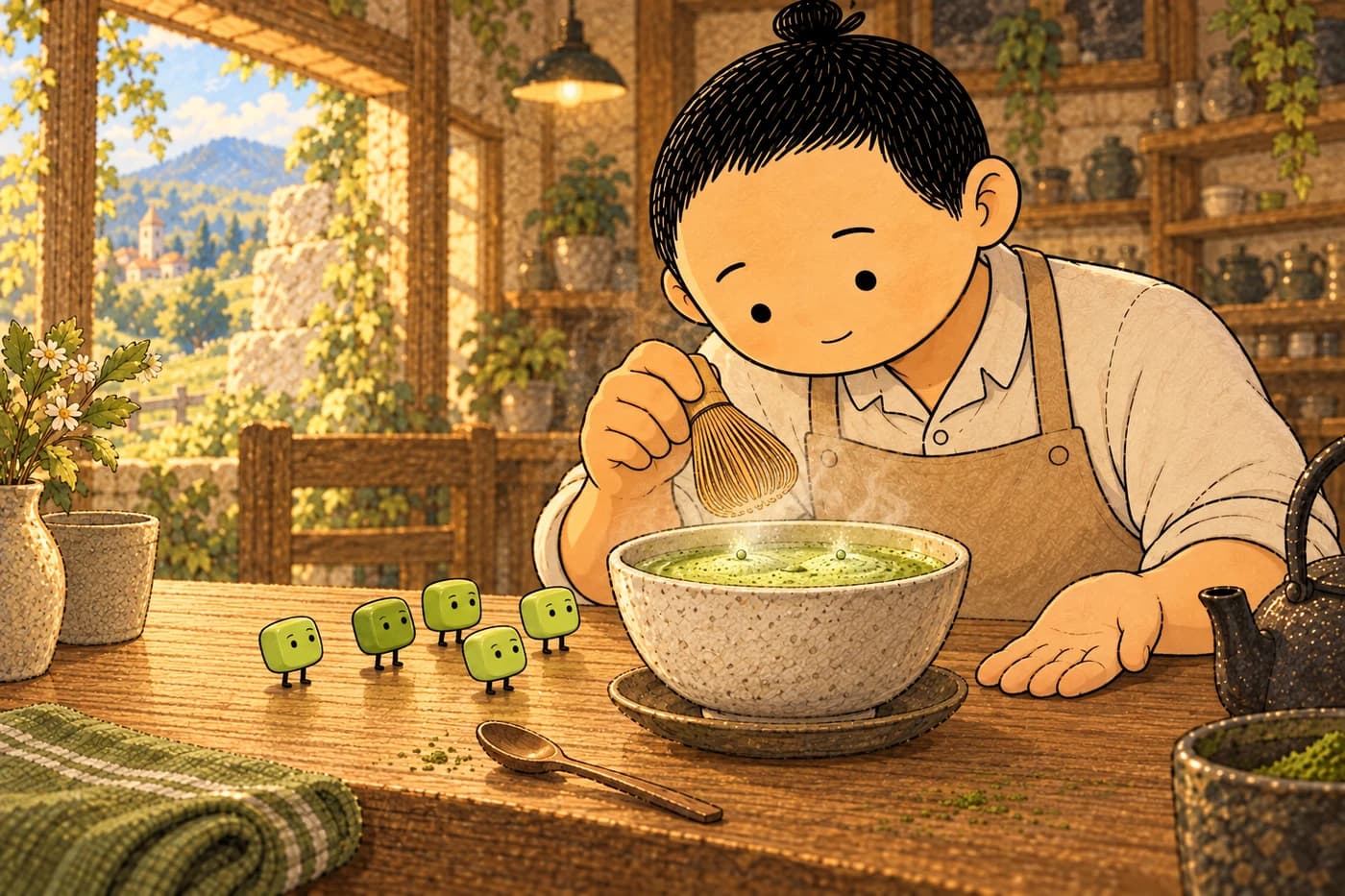
Hot water meets powder. The foam shivers. It clumps, loosens, and gathers again. Mutjo does not stir quickly. He waits for the bowl to settle. The Matji lean towards the steam. A small pulse passes through the surface. Then the foam blinks up at him. Twice.
Two new faces rise from the green. Gutji appears first, square and bright, blinking through the last wobble of foam before setting both skinny black legs firmly on the saucer. The other newcomer follows half a breath later, a little darker at one edge and already leaning towards the kettle. Each is a tiny shallow green form with two close eyes, two front eyebrows, and two skinny black legs. They are small enough to fit together in one saucer, though the saucer is immediately judged too crowded.
The original four receive the newcomers with tremendous ceremony. Katjo moves to the front. Dotjo and Yutju align beside him. Itji settles at the end of the row. Gutji and the other newcomer face them. A formal bow follows, achieved by six soft cubes leaning forward and returning upright in nearly perfect time. The dignified pause lasts very nearly a full minute. Somewhere outside, a customer coughs. Nobody breaks formation.
Then the dignity collapses. Gutji is shown the kettle, the good shelf, and the drawer where one sleeps. The other newcomer is shown the back step, the safest route beneath the counter, and the exact place where the morning light reaches the floor. They are shown the customers who see everything, the customers who see nothing, and Sir Tetsu, who now bows before drinking. Family, I have observed, is a thing one explains at top speed.
The newcomers learn by watching. Gutji follows the safe route towards the kettle, recoils when the stove clicks, then pauses and takes the same short path again. This time Gutji reaches the warm tile and holds position. The other newcomer rests beside the whisk while Mutjo cleans it. Katjo corrects a dangerous route around the stove by blocking it with his side. Dotjo provides the stable centre of a six-cube line. Across the counter they make a living choreography of attention, balance, patient pressure, and shared thought. Mutjo can feel their bond between them, but he never tries to translate it. Some things belong to the family.
At noon the queue reaches the crossroads. A child counts six green figures and gets to seven by counting the reflection. The mushrooms say this is auspicious. Sir Tetsu says nothing, but orders two bowls. Mutjo pours. Gutji and the other newcomer sit beneath the counter card, their new edges still warm from the bowl.
Before closing, Katjo leads the newcomers once more along the safe path beneath the counter. At the stove’s click, Gutji holds steady beside the warm tile. Beside Gutji, the other newcomer matches the pause. The original four answer by leaning into a close green row, leaving two spaces exactly where they are needed. At closing, the six Matji rest together beside the kettle. The shop is busier now. It is also, somehow, quieter inside. Two new lives have joined the foam, and the family has made room without needing to be told how.