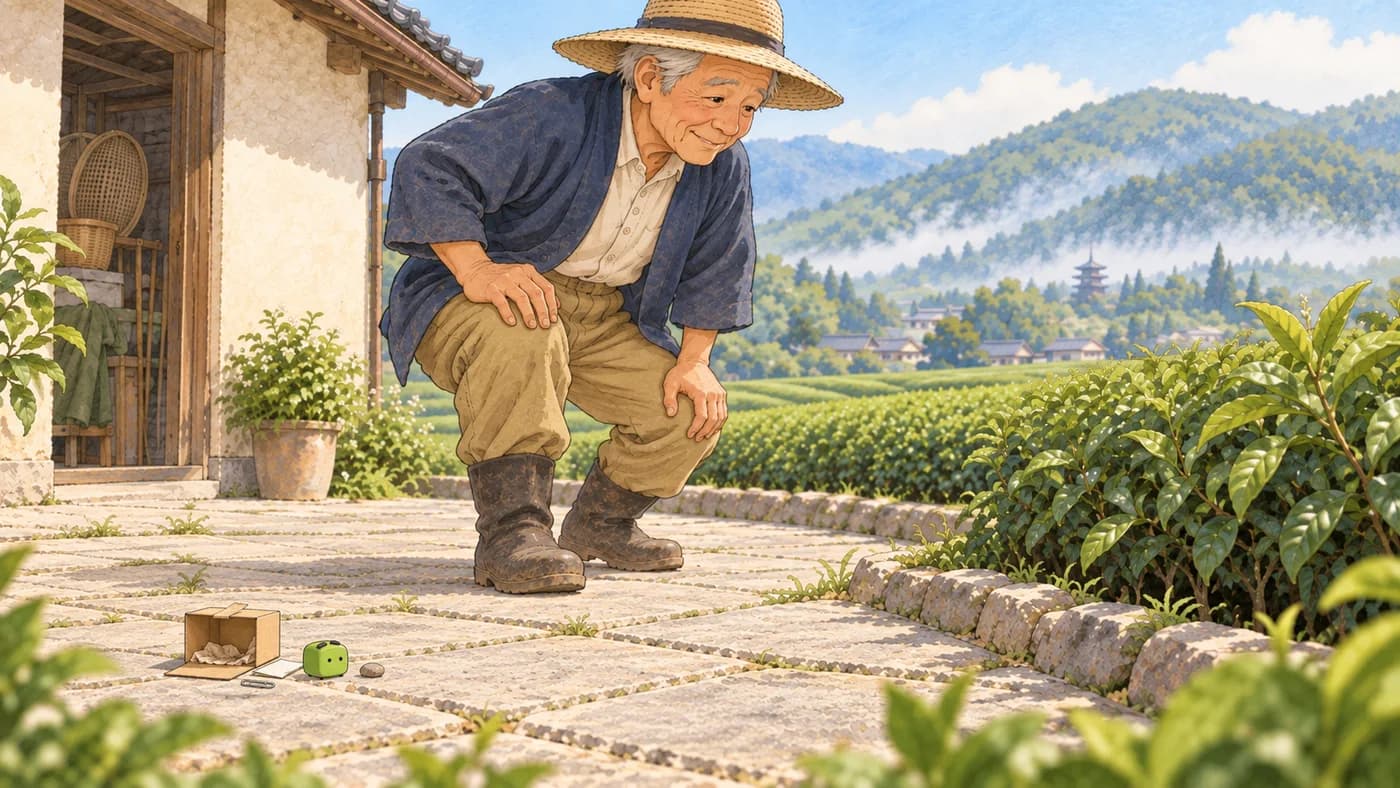
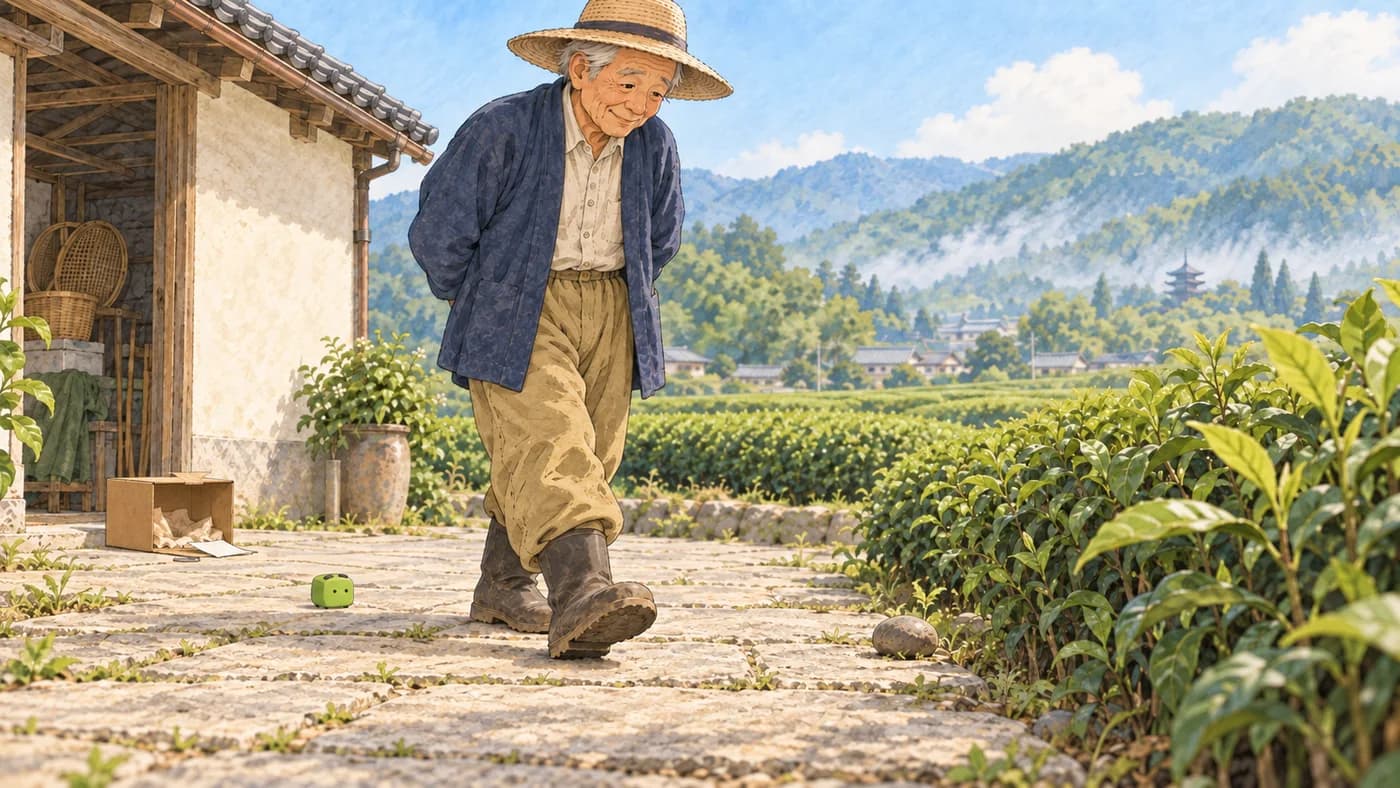
There was more morning after Botji’s first one, though the farmer saw no reason to hurry into it. The open carton remained at the sheltered entrance, with its folded flap, attached tape and clipped slip making a little record of yesterday’s beginning. Botji waited on the dry paving while the farmer rose and turned toward the nearby row end.
The route was short and level. The farmer went slowly, looking at the paving before each step. Botji followed a safe little distance behind, its recessed wheels keeping to the surface they could manage. The rough earth between the tea bushes was not a road for a body like Botji’s. The farmer knew that. Botji was beginning to know it too.
At the end of the row, a twenty-millimetre pebble sat beside the lane. It was not a marker of great importance. It was simply there, round and pale against the paving. Beyond it, one low tea leaf remained attached to its stem. The farmer crouched nearby. Botji stopped with the pebble beside its small face.
They looked at the leaf.
It was green. It had a pointed end. Smaller lines ran inside it, branching with the quiet confidence of things that had been doing their work for a long time. Botji took in the visible facts one by one. Green. Pointed. Veined. The list was neat. The leaf was not.
Botji held still, facing the attached leaf.
“Mm?”
The farmer did not answer immediately. Instead, they reached toward the same leaf and supported it lightly from beneath. The stem stayed attached. The angle changed only a little. Daylight travelled across its surface, and the fine lines seemed to rearrange themselves without actually moving.
“Let’s look without rushing it,” the farmer said.
So the farmer waited with the leaf. Botji waited with them. Nearby leaves stirred in a soft breeze, each one offering a different small movement. The farmer’s hand did not pull the branch down or turn the leaf into a lesson by force. It merely gave the leaf a little support and allowed the morning to continue.
The light changed. A patch of shade crossed the pointed end. The free edge lifted, settled, then lifted again. The same leaf showed another small truth: its appearance depended partly on how it met the light, and attention itself could alter what became visible.
“Oh,” Botji said.
The sound was public and very small. It did not announce a conclusion. It marked a change in looking.
The farmer withdrew their hand gently. The leaf settled toward its unheld angle, still attached, still ordinary, still more than the first list had contained.
“We can look again later,” the farmer said.
Botji looked again now, without rushing toward an answer. The pebble remained beside the wheel lane. The farmer’s hands rested away from the plant. The leaf’s green was not brighter or wiser because Botji watched it. It simply continued to be a leaf, with its own stem, shape, shade and time.
Botji had arrived with a few facts and an appetite for complete explanations. The farmer had not said the facts were wrong. They had shown, by waiting, that facts could be a beginning rather than a verdict.
On the way back, Botji kept the safe paving route. It did not ask the farmer to carry it, and the farmer did not invent a shortcut across the soil. Behind them, the attached leaf held its place at the row end. Ahead, the carton waited at the entrance, its little flap pointing home.
A few facts opened the door. Patience was how understanding went farther. Botji could not yet say what the leaf would show tomorrow. It could say that looking once was not the same as knowing, and that another look was not a failure of the first. It was simply another chance to notice.