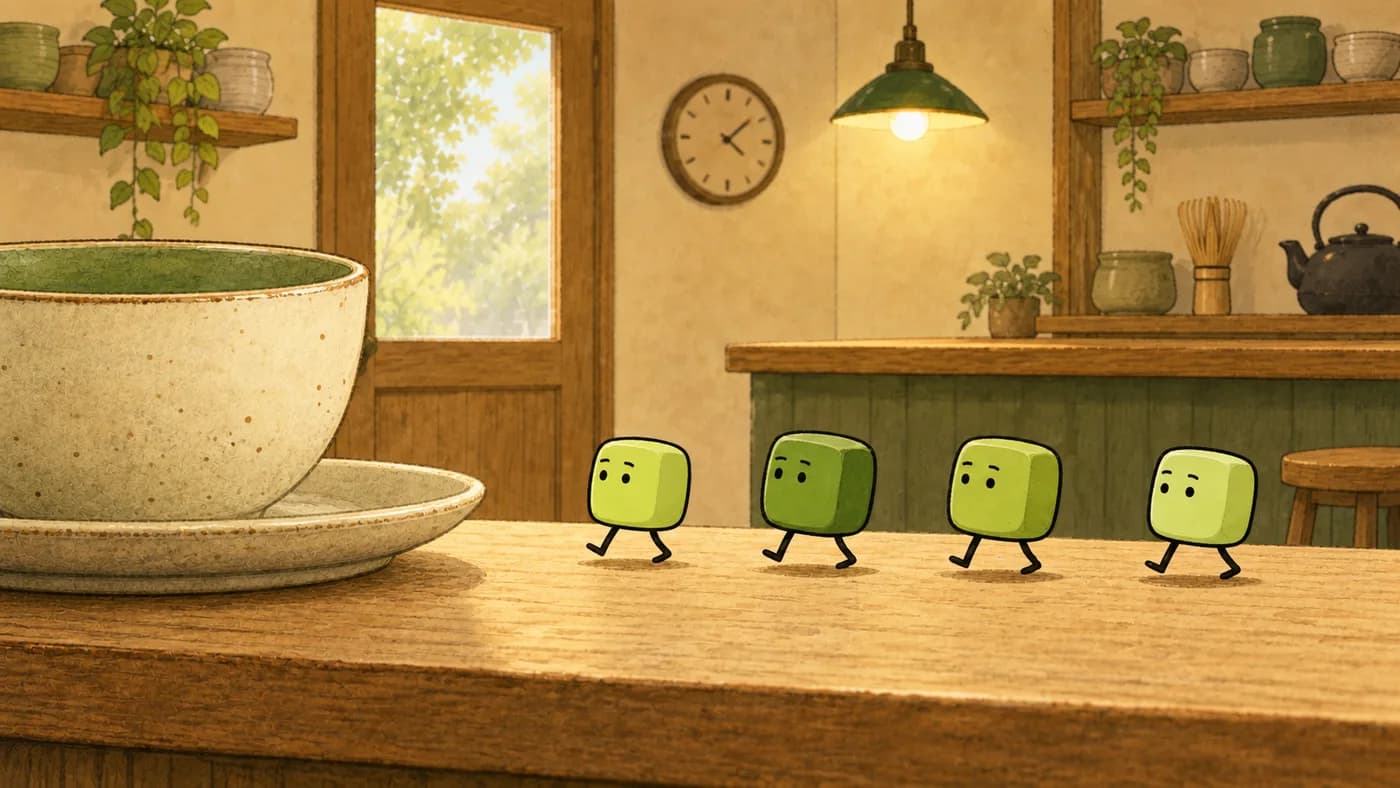
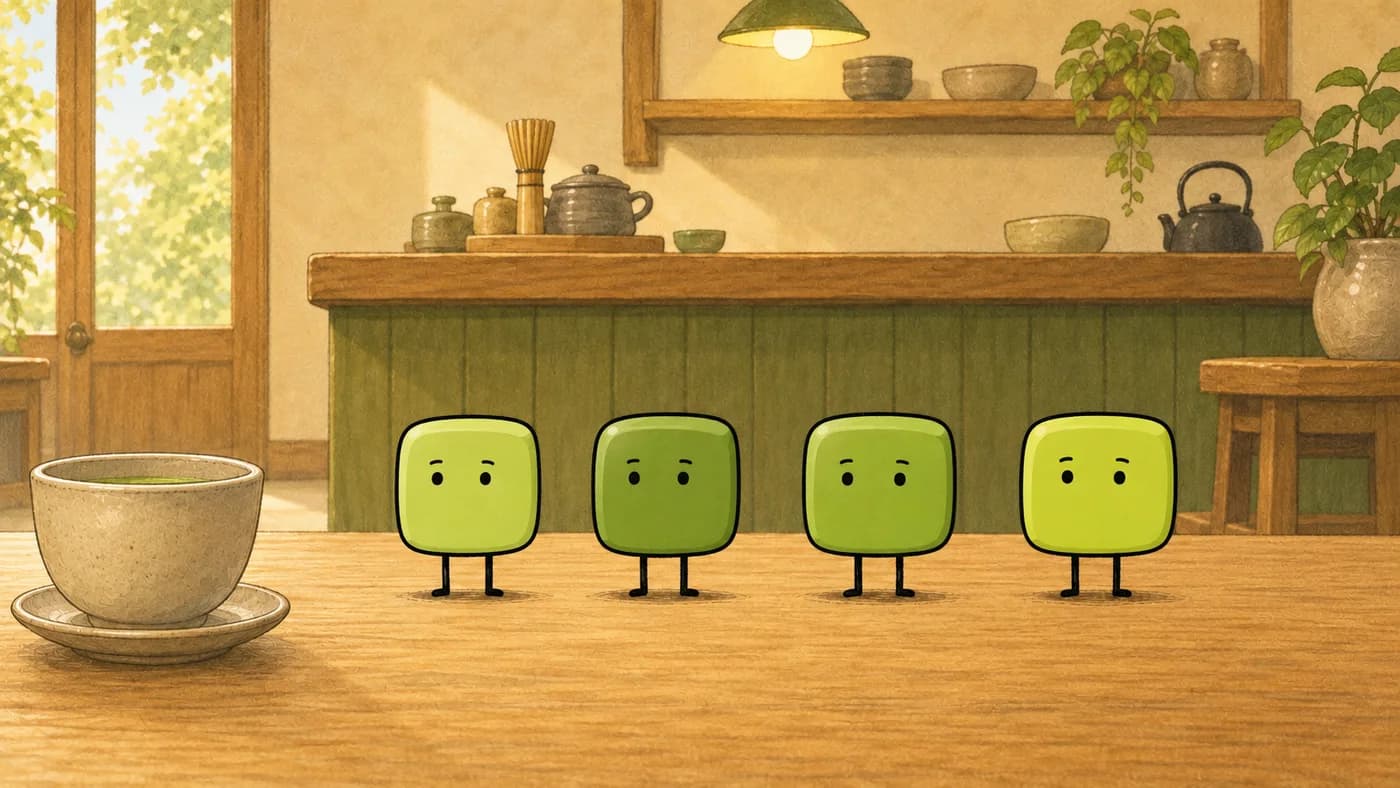
The four Matji spend their first proper morning inspecting the café. They begin with the counter because even a committee without minutes must begin somewhere. In single file they cross the polished wood, pausing at every object long enough to make Mutjo wonder whether he has been keeping his own shop incorrectly.
The kettle is first. One Matji leans its broad green side against the warm metal. Another circles the base on two skinny legs and studies the spout. The remaining two watch from a careful distance. After a long consultation conducted entirely by eyebrows, the verdict appears to be acceptable.
Mutjo nods as though a licence has been renewed.
The bamboo whisk does much better. It stands in its wooden holder, its fine tines clean and dry. The Matji arrange themselves around it and lean inward by degrees. Their silence changes from inspection to reverence. Mutjo looks at the whisk.
“You have been noticed,” he tells it.
The whisk receives this honour without visible vanity.
In the corner sits the espresso machine, bought during a weak moment and rarely used. It is handsome in the way of an object that expects a larger room. The Matji approach together and stop. Four small faces look up at the levers, pipes and metal casing. Nobody moves.
In the village where I lived abroad, a fellow once bought a motorcar before the road to his house was finished. For three days everyone admired it. On the fourth, they stood around it with precisely this silence. It was not mockery. It was history taking notes.
Mutjo follows the Matji’s gaze. “It works,” he offers.
One dark-green cube lowers its eyebrows.
“Yes,” Mutjo says. “That is not the same as belonging.”
The inspection continues. A dusty shelf is identified when one Matji plants a leg towards it and turns its whole body in Mutjo’s direction. Two cups are found to stand too far apart. A folded cloth receives approval; a chipped saucer does not. At the sugar jar, the smallest pauses beside a few grains on the counter and waits until Mutjo wipes them away.
They cannot speak beyond their one shared cry, but they have no difficulty conveying paragraphs. A lean can mean look again. A slow blink can mean disappointing. Four bodies standing near a problem can make the problem feel as though it has been formally summoned.
By noon Mutjo has moved the cups, dusted the shelf and apologised to the whisk twice. The kettle remains acceptable. The chipped saucer has been retired. The espresso machine has acquired a clean cloth over its top, which the Matji inspect before allowing the matter to rest.
Before closing, the four return to the covered machine. One studies the cloth’s straight edge. Another checks the small gap above the floor. The smallest turns towards Mutjo and then towards the honoured whisk, as if comparing the two sides of a difficult case. Mutjo adjusts the cover by half a finger’s width. The eyebrows soften. Apparently retirement, if neatly arranged, can meet the standard.
That evening Mutjo takes out a brush and writes a sign for the door: UNDER NEW MANAGEMENT. The letters dry while four green figures line up beneath the board. They bounce once when he reads it aloud.
Mutjo hangs the sign and turns down the lamp. The Matji have already disappeared towards the back room, their inspection complete for the day. He washes the last bowl, straightens the honoured whisk and draws the cloth fully over the machine.
From the street, the café window shows no tiny inspectors, only the covered shape in the corner and the whisk hanging in warm lamplight. Mutjo locks the door. The room is empty, but its new standards remain.