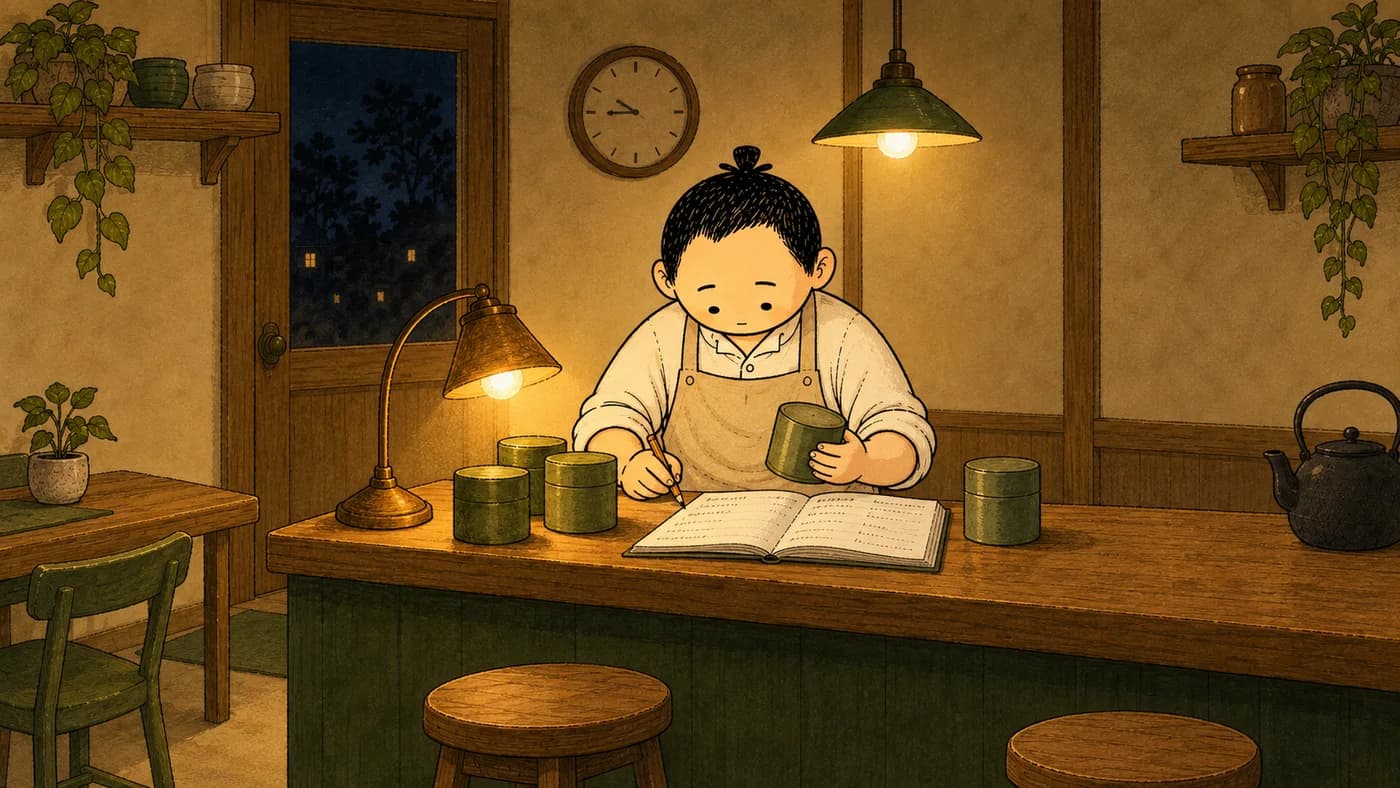
Every night Mutjo counts the tea tins before he locks the café. Every morning the numbers are wrong by a little.
The difference is never dramatic. A labelled tin that should hold twelve measures holds eleven and a half. Another seems untouched until he lifts it and feels the lighter weight. Mutjo records each figure with a short pencil, closes the ledger and begins the day without turning a small mystery into an accusation.
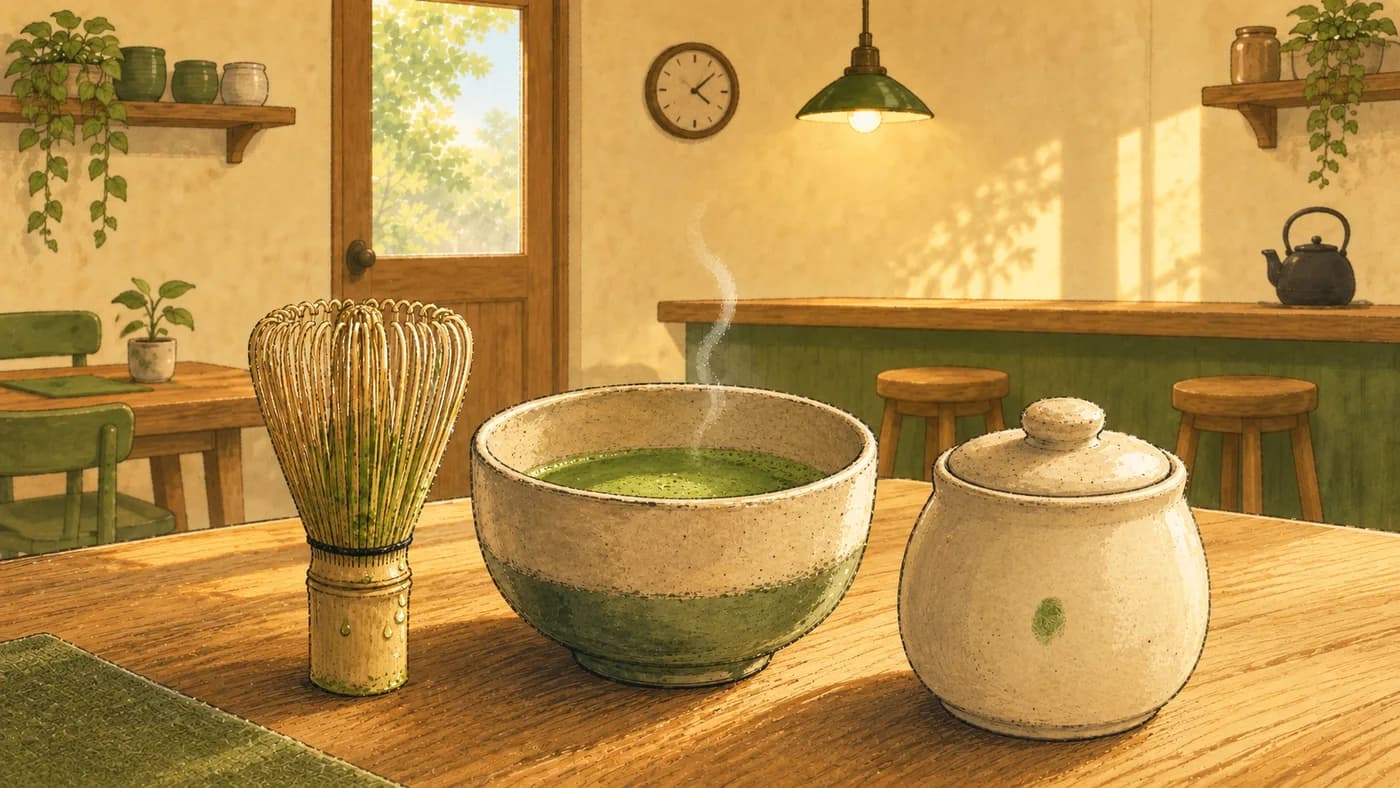
There are other signs. Some mornings the bamboo whisk is damp. Some mornings a ceramic bowl holds a trace of warmth. Once, on the sugar jar, he finds a tiny green contact mark shaped like a comma where a soft body has leaned.
He cleans the counter and leaves the mark.
That evening Mutjo closes at the usual hour. He washes the final cup, hangs the cloth and lowers the lamp. The ledger remains open beneath the window. He does not install a camera or set a trap. A man may have been trained in science and still understand that evidence can be invited rather than captured.
Moonlight moves across the floor. Four Matji emerge from the back room and gather beneath the low shelf. One presses against the plainest tin. Another leans beside it. Together they ease it towards the counter, where four thimble-sized bowls wait in a neat row.
A fountain-pen cap becomes a whisk. The smallest Matji braces beside it while the others steady the bowl with their whole bodies. The movement is careful and surprisingly accomplished. Foam rises in miniature, pale and fine beneath the lamp.
The ceremony pauses for inspection. One Matji watches the rim, one the centre and one the cap. The smallest studies the surface, then gives a restrained bounce. In a room this quiet, the landing sounds almost official.
They share the tea in drops. No one speaks. The open ledger lies at the edge of the light, its ruled columns waiting without judgement. When the tiny bowls are empty, the Matji return the cap to its place and make their way towards the tea-towel drawer.
At dawn Mutjo finds four green cubes resting on folded cream towels. Their eyes are open, but their stillness has the settled quality of sleep. He places one hand on the drawer edge and waits. The smallest turns its face towards him without moving anything else.
Mutjo slides the drawer nearly shut, leaving a comfortable gap.
He examines the counter. The whisk is damp. The thimble bowls are clean. The pen cap has been returned with more care than he usually gives it. In the ledger, the figures remain wrong by exactly the amount of a very small ceremony.
On the lowest shelf he places one unlabelled ceramic tin. It sits at Matji height beneath the other tea, plain enough to be mistaken for storage. Mutjo makes no announcement. Four sets of eyebrows rise from the drawer gap.
The following morning, the labelled tins are correct. The unlabelled one is almost correct, which is a different and much friendlier kind of arithmetic. Mutjo writes a small mark at the bottom of the ledger, away from the inventory columns, where one might record a household custom.
He warms the first bowl of the day. Behind him, the drawer opens by a fraction. Four Matji cross the counter and pause beside the low tin. The smallest notices the green comma on the sugar jar and leans beside it, adding no new mark.
Mutjo sees this in the window reflection. He pretends to be occupied with the kettle.
The mystery has not been solved because it was never a problem. The café has acquired an after-hours tea ceremony, a low shelf and an understanding that good manners include returning the whisk. Mutjo closes the ledger.
That night he leaves the lamp turned slightly towards the counter. The unlabelled tin waits below it. From the tea-towel drawer comes the faint click of four bodies arranging themselves in a row, and the shop settles around its newest routine.